About Latrodectus geometricus C.L.Koch, 1841
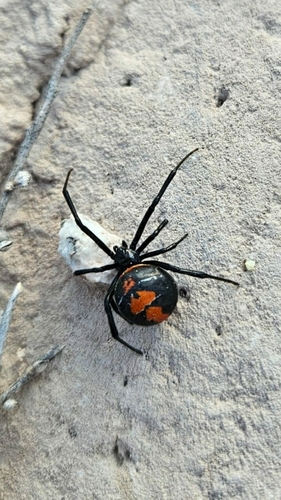
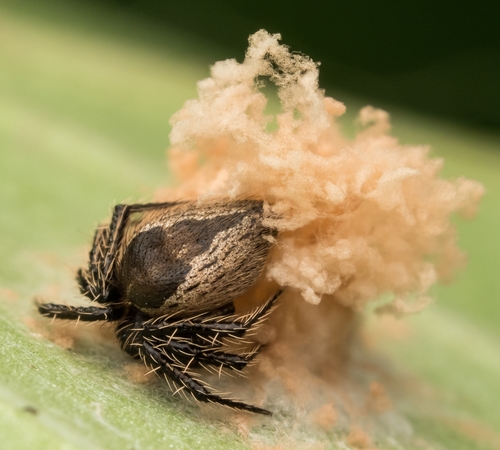
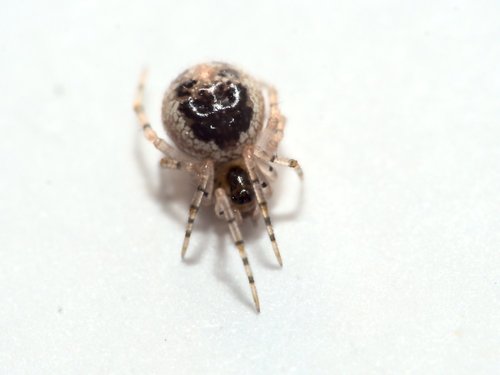
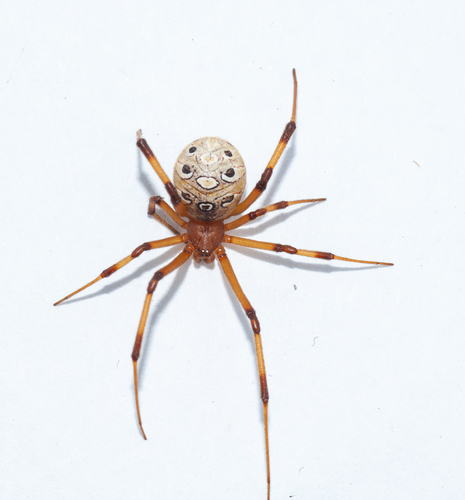
Latrodectus geometricus is slightly smaller and generally lighter in color than other black widow species, with colors ranging from tan to dark brown to black, and grey shades are also possible. Like native United States black widow species, L. geometricus has a prominent hourglass-shaped marking on the underside of its abdomen. Unlike the marking of other black widows, the brown widow's hourglass is usually a vivid orange or yellowish color. Unlike other black widows, L. geometricus also has a black-and-white geometric pattern on the dorsal side of its abdomen, and has stripes on its legs. Brown widows can be located by their easily identifiable egg sacs. The egg sacs resemble a sandspur, with pointed projections covering their surface, and are often described as "tufted", "fluffy", or "spiky" in appearance. Eggs hatch in approximately 20 days. Female brown widows lay about 120 to 150 eggs per sac, and can produce up to 20 egg sacs over their lifetime. This species constructs three-dimensional webs in dark corners across a variety of microhabitats, and is commonly found around human houses. The species builds webs with a retreat, from which delaying retreats radiate out. Sticky threads are laid from the delaying threads down to the ground. The retreat has either one or two openings, and the main opening opens onto the delaying threads. Webs are built at varying heights above ground, in vegetation and around buildings. In South Africa, Latrodectus geometricus inhabits a large range at altitudes from 0 to 1941 meters above sea level. It has been sampled from all floral biomes in South Africa, and is commonly found in crops including avocado, citrus, cotton, maize, pistachio, prickly pears, and vineyards. The brown widow has a cosmopolitan distribution. The World Spider Catalog lists its native distribution as Africa, and it has been introduced to the Americas, Poland, the Middle East, Pakistan, India, Thailand, Japan, China, Papua New Guinea, Australia and Hawaii. Some researchers think it may have originated in South Africa, though this is not certain, as specimens have been discovered in both Africa and South America. Brown widows are usually found around buildings in tropical areas, can compete with black widow spider populations, and have been recorded in many areas of South Africa, the United States (including Hawaii), Australia, Japan, the Dominican Republic, Costa Rica, and Cyprus.