About Lathyrus vernus (L.) Bernh.
Scientific Classification and Growth Form
Lathyrus vernus (L.) Bernh. is a perennial plant with an upright, non-winged stem. The stem is erect, nearly hairless, and reaches a height of 20 to 40 cm (8 to 16 in).
Leaf Arrangement and Stipules
Its leaves grow in an alternate arrangement, have short stalks, and feature large, wide stipules.
Leaf Blade and Leaflet Structure
The leaf blades are pinnate, with two to four pairs of ovate leaflets that taper toward blunt tips, have entire margins, and do not produce tendrils.
Inflorescence and Flower Size
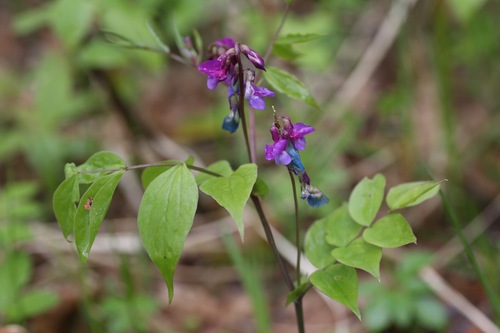
The inflorescence grows on a long stem and holds three to ten purplish-red flowers, each 13 to 20 mm (0.5 to 0.8 in) long.
Flower Morphology
Flowers turn bluer as they age, and have five sepals, five irregular petals: the uppermost petal is called the "standard", the two lateral petals are called "wings", and the lowest two petals are joined to form the "keel". Each flower has ten stamens and one single carpel.
Fruit and Seeds
The fruit is a long brown pod, growing up to 60 mm (2.4 in) in length, that contains eight to fourteen poisonous seeds.
Flowering Period
This plant flowers early in the year during May and June.
Species Distinction Characteristics
It can be told apart from bitter vetch (L. linifolius) and black pea (L. niger) by the broad width of its ovate leaflets.
Post-Flowering Growth Pattern
Unlike some related species, it does not wither after flowering and continues growing until autumn.
Native Range
Lathyrus vernus is native to Europe and parts of northern Asia.
Habitat
Its most common habitat includes broad-leaved woodland, forest margins, plantations, and clearings.