About Lathyrus tuberosus L.
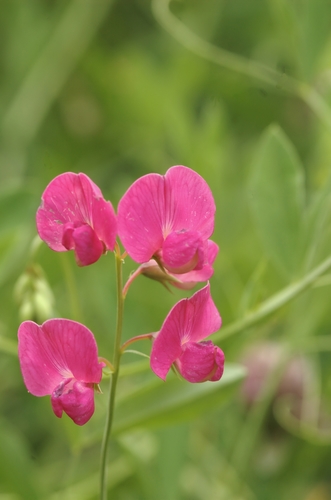
Lathyrus tuberosus L. is a perennial plant that produces edible tubers measuring 3 to 5 cm (1.2 to 2.0 in) long, which attach to its stolons. Its sprawling, wingless, nearly hairless stems reach 30 to 80 cm (12 to 31 in) in height. Leaves grow alternately, with short stalks and narrow stipules; leaf blades are pinnate, featuring a single pair of broad lanceolate leaflets with blunt tips, entire margins, and a terminal tendril. The inflorescence has a long stem and holds 2 to 7 pinkish-red flowers, each 12 to 20 mm (0.5 to 0.8 in) long. Flowers have five sepals, five irregular petals (one standard, two wings, and a fused keel), ten stamens, and a single carpel. The fruit is a brown pod that holds up to six seeds. Tubers of this species are found 14 cm below the soil surface, and its mostly unbranched roots can reach a depth of 70 cm. This species flowers from late May to August. Lathyrus tuberosus originated in Western Asia and Eastern Europe. It is thought to have spread across central Europe alongside cereal cultivation. It was later introduced to North America, and can also be found in Northern Africa. Today, it is classified as an endangered species in Switzerland and Austria. Its typical habitats include rough grassy areas, broad-leaved woodland, forest margins, hedgerows, and banks. It prefers alkaline, calcareous, loamy soils that are rich in fine particles, though it also grows on stony ground. In warmer, drier regions, it depends on near-surface soil moisture due to its root structure. It can grow at altitudes up to 2000 m above sea level. This species can reproduce both vegetatively via tuber multiplication and sexually via seeds. Its flowers are hermaphroditic and pollinated by bees. Mature seed pods of L. tuberosus typically only hold a small number of viable seeds, and mature seeds are sometimes infested by the beetle Bruchus affinis and hymenopterans. Seed germination rate at 20 °C after 50 days is very low, but scarifying the seed coat heavily increases germination rates. After germination, L. tuberosus grows very quickly, producing seed pods and small tubers within the first year. As the plant develops, tubers produce stolons and new roots; tubers can also develop new stems to grow as independent plants. Tubers can be divided when the plant is dormant in autumn. Vegetative propagation of L. tuberosus is very successful, and sexual reproduction likely only serves to create genetic diversification or allow colonization of new habitats. This diploid plant has 14 chromosomes, and there is high variation in the percentage of constitutive heterochromatin between individual plants. During endosperm formation and embryo development, protein bodies form, and all cells of the embryo’s organs participate in protein storage accumulation. The ploidy level of seed nuclei correlates with the total volume of protein bodies in the seed, meaning breeding could increase seed protein levels by increasing ploidy. In modern times, L. tuberosus is occasionally grown in central European allotments for its scent, ornamental appearance, and edible tubers. In the 16th century, its flowers were distilled to make perfume. In the 18th century, it was grown on a larger scale in the Lower Rhine Valley of Germany and the Netherlands; after harvest, tubers were cooked or roasted for human consumption, and this root legume, described as having a gentle nutty flavor, was in demand on French markets. Tubers were occasionally used to make fermented beverages or bread, while oil was pressed from its seeds. Promising 20th-century experiments tested L. tuberosus as a forage crop. Recent studies from Turkey confirm that rural populations still harvest and consume the above-ground tissue of this species as a wild food. Adapted to a broad range of growing conditions, L. tuberosus can thrive in soils where other crops fail to grow. It resists high soil salinity, and plants with higher salt tolerance have been observed to have even higher photosynthesis rates. This legume shows a strong negative response to ammonium nitrate nitrogen fertilizer. Despite being palatable and nutritious, commercial cultivation of L. tuberosus is limited by low yields, as it requires two to three years of growth to produce reasonably sized tubers. A 1968 attempt to increase yields through improved cultivation techniques and hybridization revealed the species has high breeding potential, resulting in a six-fold increase in tuber yield. This plant is attractive to gardeners but is susceptible to slug damage. It is classified as a noxious weed in Ontario, and commercial herbicides sold in Europe target this species.