About Lathyrus sphaericus Retz.
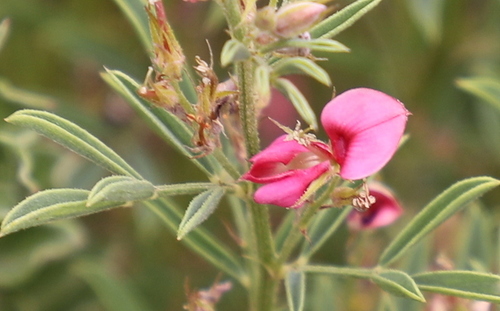
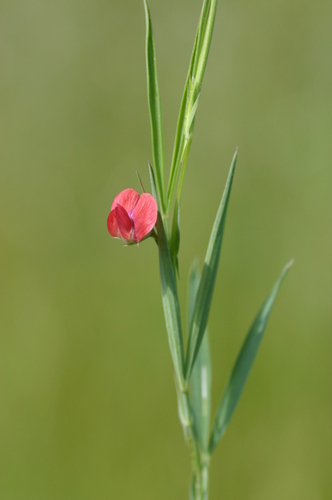
Lathyrus sphaericus Retz. is an annual herbaceous plant that usually grows 15–30 cm tall. Its stems grow upright or occasionally climb upward, and both stems and leaf stalks (petioles) have few or no wing-like outgrowths. Each leaf is made up of a single pair of hairless (glabrous) leaflets that measure 2 to 8 cm long. These leaflets are linear to lance-shaped, with parallel veins running along their length. Lower leaves generally end in a sharp, bristle-like tip, while upper leaves terminate in a simple, undivided climbing tendril. Small, narrow stipules (leafy appendages at the base of the leaf stalk) are present, with a shape similar to an arrowhead (sagittate).
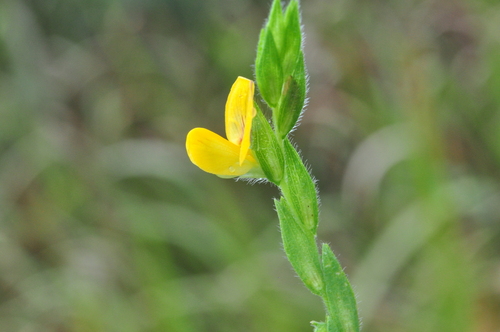
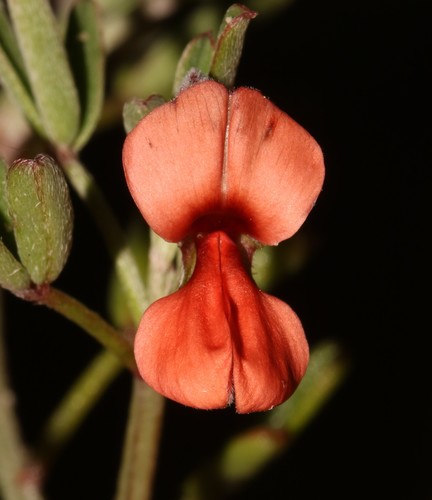
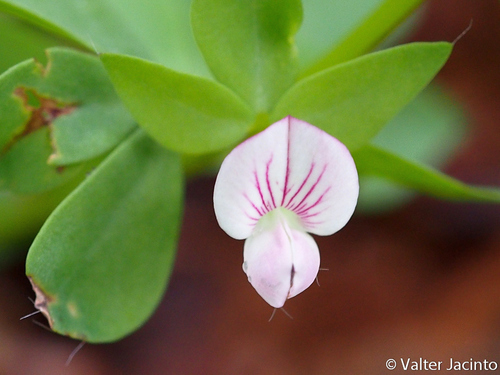
Each elongated flower stalk (peduncle) holds only one flower; it appears to extend past the flower due to a small bract (bracteole). The calyx (the collective structure formed by the flower’s sepals) is hairless, and its short, pointed upper teeth are roughly equal in length, only slightly longer than the calyx’s tubular base. The flowers are brick-red and around 10 mm long.
After flowering, the plant produces flat, smooth, hairless seed pods 4 to 6 cm long. The pods hold spherical, smooth seeds about 4–5 mm across, which gives the species its scientific name sphaericus. Flowering typically occurs in May, and the plant has a chromosome count of 2n=14.
Visually, Lathyrus sphaericus is similar to several related species, most notably Lathyrus cicera. Lathyrus cicera can be distinguished by having calyx teeth 1.5 to 3 times longer than the calyx tube, and larger, angular seeds. Two other similar species, Lathyrus setifolius and Lathyrus angulatus, do not grow in Switzerland, which simplifies identification of Lathyrus sphaericus within that native range.
Lathyrus sphaericus most often grows in warm, moderately sunny locations. It prefers loamy-clay soils that may sometimes be unstable; these soils can be either calcareous (containing calcium carbonate) or non-calcareous, but are generally nutrient-rich and dry. The species is often a short-lived opportunistic plant, commonly found along roadsides, in disturbed areas, vineyards, waste ground, agricultural fields, fallow land, and heavily grazed sheep pastures. It can also grow at the edges of dry oak forests and shrubby areas, and in dry, patchy grasslands. In Switzerland, it grows at elevations between 380 and 1030 metres, while in Italy it occurs from sea level up to 1200 metres, and it occupies a wide ecological range.
Naturally, it occurs in specific grassland communities including Festucetalia vallesiacae, Sedo-Scleranthetalia, Jasione-Brometum, and Geranion sanguinei. It can even grow in recently abandoned cereal fields, steppe fragments within vineyard areas, and various roadside and ruderal (disturbed) plant communities.
The species is mainly distributed across Mediterranean and sub-Mediterranean regions, spanning from the Iberian Peninsula in the west to the Balkans in the east. The northern edge of its range roughly follows the Loire Valley in France, crosses the southern fringes of the Alps in Switzerland and Italy, and extends further east to the Hungarian basin along the Danube River and into Crimea. Additional established populations occur on Rhodes (Greece), in the Caucasus region, North Africa, and Madeira. Occasional, temporary occurrences have been recorded further north in southern Germany, on the Danish island of Bornholm, and as far north as Sweden.
In 2020, Lathyrus sphaericus was rediscovered in Slovakia after being considered regionally extinct for over 90 years. A population was found on the dry, rocky slopes of Kusá hora hill near Kozárovce, in the southern part of the Štiavnické vrchy Mountains of southwestern Slovakia. This site has species-rich, dry grassland typical of warm habitats growing on volcanic bedrock. Following this rediscovery, the species' conservation status in Slovakia was updated from regionally extinct to critically endangered. This rediscovery follows similar records in nearby northern Hungary, which suggests that climate change and warmer conditions may allow this Mediterranean plant to expand its range further northward.