About Lathyrus niger (L.) Bernh.
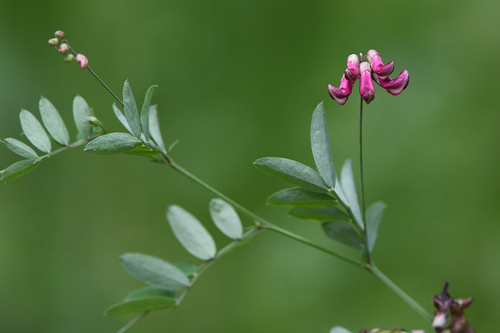
Lathyrus niger (L.) Bernh. is a perennial plant with erect, self-supporting stems that reach 30 to 80 cm (12 to 31 in) in height. Its stems are branched, unwinged, and nearly hairless. Leaves grow in an alternate arrangement, with short winged stalks and narrow stipules. Leaf blades are pinnate, bearing four to eight pairs of narrow elliptical leaflets that have sharp tips, entire margins, and no tendrils. The underside of the leaflets is bluish-green. Inflorescences develop from leaf axils and are often one-sided. They have long stems and hold two to ten red flowers, each 10 to 16 mm (0.4 to 0.6 in) long, which turn bluer as they age. Each flower is irregular, with five sepals, five petals, ten stamens, and a single carpel. The five petals have distinct forms: the uppermost is called the "standard", the two lateral petals are called "wings", and the lowest two petals are joined to form the "keel". The fruit is a long black pod that holds up to eight seeds. This plant flowers during June and July. Lathyrus niger is native to Europe and parts of Asia. Its typical habitat includes broad-leaved woodland, forest margins, woodland clearings, and plantations. In ecology, the flowers of Lathyrus niger are pollinated by bees; smaller insects cannot reach the flower's nectar source. Young, nectar-producing red flowers are visited by bees, but once pollinated, the flowers turn blue and stop producing nectar, so bees visit other flowers instead. At the end of the growing season, as the foliage withers, the entire plant turns black.