About Lathyrus L.
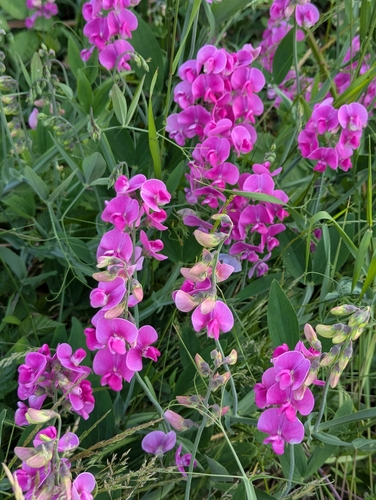
Morphology: Lathyrus latifolius has winged, hairless stems, with alternating blue-green compound leaves. These leaves are made up of one single pair of leaflets, and a winged petiole around 2 inches (51 mm) long. The leaflets are narrowly ovate or oblong-ovate, with smooth margins, are hairless, and grow up to 3 inches (76 mm) long and 1 inch (25 mm) across. A branched tendril sits between the two leaflets. Reproduction: Lathyrus latifolius can reproduce both vegetatively from its taproot and rhizomes, and sexually from seed. Cultivation and habits: Lathyrus latifolius is a perennial herbaceous climbing vine. It can reach 6 feet or more in length by twining around supports with its tendrils, but will sprawl across the ground when growing in open areas. It is frost-hardy, long-lived, and spreads slowly. By the end of summer, its foliage becomes quite ragged and turns yellowish. It grows best in partial to full sun, and in loam or clay-loam soil that is moist, mesic, or slightly dry. Unlike the related annual sweet pea, Lathyrus odoratus (a species it is often confused with), Lathyrus latifolius has no scent. Though it is grown as a garden plant, it can become pervasive and very difficult to remove. For this reason, it is often classified as a weed, even though it has an attractive appearance. Many cultivars have been selected for garden use. The following cultivars of Lathyrus latifolius have earned the Royal Horticultural Society's Award of Garden Merit: the pink species type, 'Albus' (white), 'Rosa Perle' (pale pink), and 'White Pearl' (white).