About Lathyrus japonicus Willd.
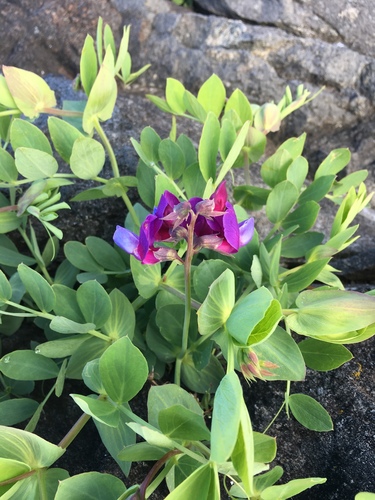
Lathyrus japonicus Willd. is a perennial plant. Its limp, wingless stems grow to 15–30 cm (6–12 in) long, and are often hairless. The leaves are alternate, greyish green and somewhat succulent, almost stalkless with large, wide stipules. The leaf blades are pinnate, with 3 to 5 pairs of narrow lanceolate leaflets that have blunt tips and entire margins, plus a terminal tendril.
The inflorescence has a long stem, and bears 5 to 12 purple flowers, each 14 to 20 mm (0.6 to 0.8 in) long. Flowers turn bluer as they age; they have five sepals, five petals, and an irregular structure consisting of a standard, two wings, and a fused keel. There are ten stamens and a single carpel per flower. The fruit is a long brown pod that grows up to 50 mm (2.0 in) in length.
This plant flowers in mid-to-late summer: July and August in the Northern Hemisphere, and January and February in the Southern Hemisphere. Lathyrus japonicus is native to temperate regions of Europe, Asia, North America, and South America. Its typical habitat is sandy or stony seashores and other coastal locations. Its unusually extensive native range is explained by the ability of its seeds to remain viable while floating in seawater for up to five years, allowing the seeds to drift across large distances. Germination occurs when waves abrade the hard outer seed coat against sand or gravel.
The pods of Lathyrus japonicus can be eaten, but like many members of the genus Lathyrus, they contain β-oxalyl-L-α,β-diaminopropionic acid, which can cause a paralysis called lathyrism. The leaves of this plant are used in traditional Chinese medicine.