About Lathraea squamaria L.
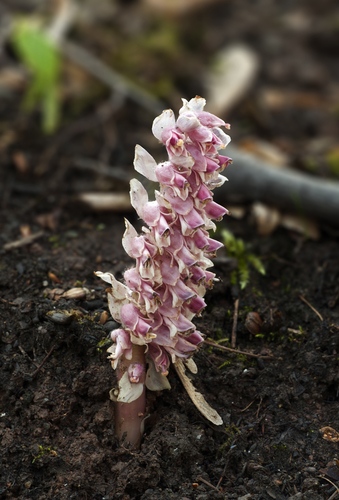
Lathraea squamaria L., commonly known as toothwort or common toothwort, is a perennial heterotrophic plant. In late spring, it grows clumps of low, hairy flowering shoots that reach 3 to 9 inches (8 to 23 cm) tall and form one-sided spikes. The shoots do not contain chlorophyll. The plant’s leaves are reduced to just a few scales on the stem. These scale-like leaf structures secrete water that escapes to soften the ground surrounding the plant. Its lack of chlorophyll and reduced leaf area clearly show its heterotrophic nature. Individual pinkish flowers are drooping, borne on short stalks, and feature two lips and open mouths. The calyx teeth are blunt and covered in hairs. This species is widely distributed across Europe, with a range that stretches from France and Norway to Russia, Bulgaria, Italy, and Greece. In the British Isles, it occurs in England and Northern Ireland, and is found less commonly in lowland areas of East England, Southwest England, Wales, Scotland, and the Republic of Ireland. Its natural habitats include deciduous woodland, hedgerows, and the banks of rivers and streams. It grows at Hatherton Flush, a Site of Special Scientific Interest located in Cheshire.