About Lathraea clandestina L.
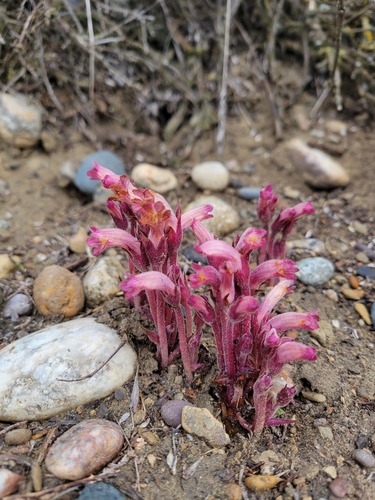
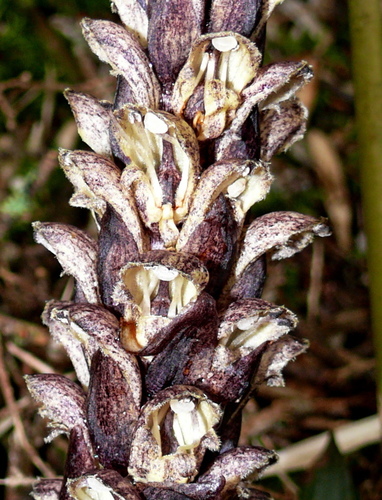
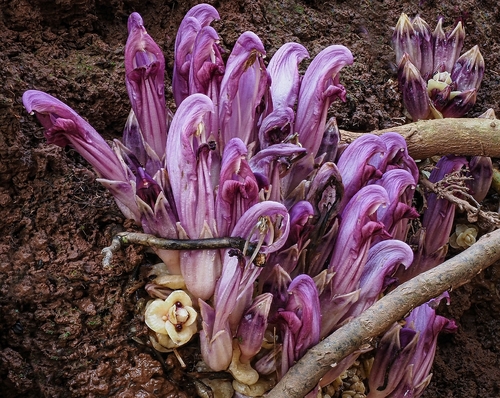
Lathraea clandestina L., commonly called purple toothwort, is a holoparasitic plant that lacks both leaves and chlorophyll. It obtains nutrients from the roots of its host plants through specialized sucking structures known as haustoria. Its large subterranean portion, which can weigh several kilograms, is made up of white stems covered in fleshy scales. The flowers measure 40 to 50 mm, have long pedicels, and emerge close to the ground between April and May. The typical flower color is purple or purplish-violet, though rare colonies with paler pink or completely white flowers can occur. When mature, the fruits eject their 4 to 5 large seeds some distance away from the parent plant. After flowering and fruiting, the plant disappears from the surface until the next spring. Seedlings grown from seed take approximately ten years to produce their first flowers. Since the species flowers and fruits during spring when sap flow in host plants increases, host plants suffer very little harm from this parasitism. Purple toothwort grows mainly in western and southern Europe. Its main continuous range extends from western Belgium, where it is locally abundant in the Flemish Ardennes, south through western and central France to northern Spain, with isolated local populations in central Italy. In France, it is found almost exclusively southwest of the Loire river, extending to the Pyrenees, with a northern extension north of the Loire into southeastern Brittany and the departments of Mayenne, Orne, and Sarthe. It is protected in some French departments, but remains relatively common and unprotected in the wetlands of Charente and Charente-Maritime. In Spain, it occurs primarily in the Cantabrian Cordillera, extending to Galicia where it is rare. Populations located far from the continuous Franco-Iberian range are likely the result of either deliberate or accidental introductions of host trees that were already parasitized by the species. Isolated introduced populations that have become locally naturalized occur in other parts of France (Alsace), the Netherlands, Italy, Germany, and the British Isles, where they grow mostly in parks and old gardens. At Arduaine Garden in Argyll, purple toothwort grows on the roots of various ornamental trees and shrubs in the absence of its typical native hosts; cats in this garden are often seen rolling in the flowers and eating them. Purple toothwort prefers to grow in damp valley bottom woodlands, usually near streams, where it parasitizes the roots of various plants. Its most common hosts are the deciduous trees poplars (Populus) and willows (Salix). It has also been recorded parasitizing a wide range of other plant species, including Acer, Alnus, Buxus, Carpinus, Corylus, Juglans, Metasequoia, Quercus, Rhododendron, Taxus, and even Gunnera.