About Lasius fuliginosus (Latreille, 1798)
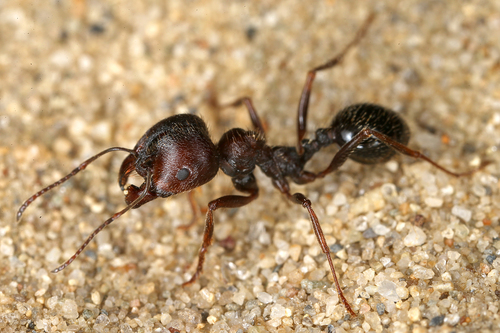
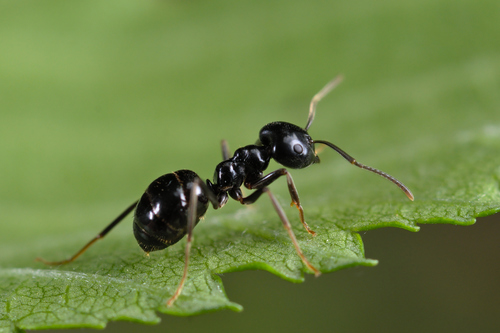
Workers of Lasius fuliginosus are black and shiny, with a relatively large, broadly cordate head that has a distinct posterior emargination and rounded occipital lobes. Sparse pubescence and scattered erect hairs cover the body dorsum, and worker legs are brownish yellow. Workers reach approximately 4–6 mm in length. Queens are also black and shiny, with a body shape similar to workers. Their pubescence and body hairs are more abundant than in workers, but the metapleural gland orifice has no guard hairs. A queen's head is heart-shaped, broadly emarginated, and wider than the alitrunk. Additionally, the scutum overhangs the pronotal convexity. Queen legs are brownish yellow and noticeably longer than worker legs. Queens measure 6–6.5 mm, making them larger than workers. Males are smaller, reaching 4.5–5 mm in length. Males have suberect hairs on the extensor surface of their tibiae, or on their antennal scapes, or both. This species has a wide distribution across Europe and Asia. Its range extends west to Portugal and Ireland, north to Finland, south to Italy, and east as far as Korea and Japan. In the UK, this species was occasionally found further north before 1970, but is now mostly found south of The Wash, in East Anglia and Southern England, with only a small number of colonies recorded in Ireland. This species builds "cardboard" nests inside old hollow trees. The nest material is a mixture of chewed wood and saliva, similar to the material termites use, that is referred to here as "board". Each nest holds only one queen, but a large colony can contain up to 15,000 workers. Like other black ants, Lasius fuliginosus tends aphid populations to collect their honeydew. Individual workers can often be seen travelling in both directions along long scent-trails leading to food sources, which are most often trees. The foraging and food transport trails created by this species commonly remain in use for months. Workers clear vegetation and debris from these paths, allowing large numbers of ants to travel efficiently along the route. Lasius fuliginosus workers rarely carry other insects back to the nest. Unlike other black ants such as Lasius niger, which found their own nests independently, a post-nuptial queen of Lasius fuliginosus cannot start her own nest on her own. Instead, she establishes a colony through social parasitism of another Lasius species: Lasius umbratus, a rare underground-dwelling yellow ant. Lasius umbratus differs from the common yellow ant Lasius flavus, which makes small mounds in grass and lawns. The invading queen kills or drives out the existing resident queen of the host nest, then lays her own eggs, which the resident host workers care for. Her offspring workers gradually take over all functions of the nest. Lasius umbratus itself establishes new nests the same way, by taking over nests of the common black ant Lasius niger. For this reason, Lasius fuliginosus is sometimes called a hyperparasite. This strategy of taking over another species' nest gives Lasius fuliginosus queens a considerable survival advantage. In Lasius niger, the smaller but much more common UK black ant species, a founding queen starts her own nest by laying eggs, then feeds newly hatched larvae using a fluid produced by breaking down her own muscles. This process leaves the queen very weak, because she cannot both tend her larvae and forage for food at the same time.