About Lasius flavus (Fabricius, 1782)
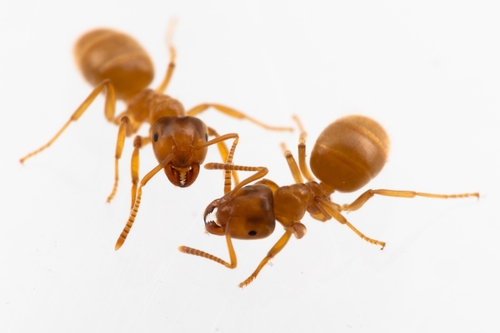
The yellow meadow ant, scientifically named Lasius flavus, is also commonly called the yellow hill ant. This ant species is native to Europe, where it is one of the most common ant species, as well as Asia and North Africa. As of 2018, populations that were previously classified as Lasius flavus in North America are now recognized as a separate related species, Lasius brevicornis. Queens of this species measure 7 to 9 mm in length, while males measure 3 to 4 mm, and workers measure 2 to 4 mm. Body color ranges from yellow to brown, with queens and males showing slightly darker coloration than workers. This species lives primarily underground, most often in meadows and very commonly in lawns. Nests are frequently completely overgrown by grass, but their presence is usually revealed by small mounds of loose soil between grass stalks. They will also build nests under large rocks or concrete slabs. Nests built in lawns eventually become noticeable, because the aphids that the ants tend clear sections of grass or portions of gardens. The yellow meadow ant feeds primarily on honeydew produced by root aphids, which the ants breed inside their nests. During the winter, the ants sometimes eat the aphids themselves. Due to this feeding behavior, the species only occasionally forages above ground outside the nest. Traits that reflect their underground lifestyle include reduced pigmentation and smaller eye size, when compared to closely related species such as the black garden ant. This is a timid ant species; when facing invaders, they often simply barricade their tunnels to defend the nest. Winged unmated queens and males, called alates, can be observed on warm days and evenings in July and August. This is one of the few times these ants are seen above ground, because workers open nest entrances and herd the young winged ants out of the nest. New colonies are often founded by multiple queens, a process called pleometrosis. After the first group of workers emerges, fights break out between the founding queens, and only one queen remains in the colony, resulting in a monogyne colony structure. However, this species can also form single large colonies that hold multiple queens and up to 250,000 workers, when the colony spreads across multiple interconnected nests.