About Lasius aphidicola
Scientific name: Lasius aphidicola
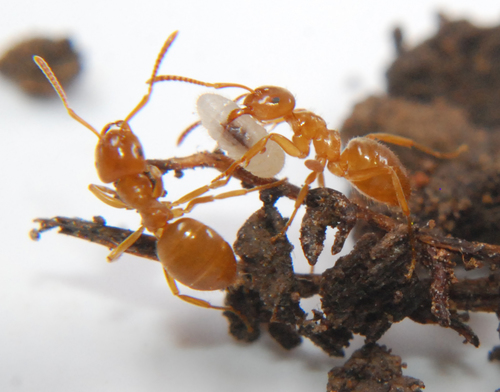
Lasius umbratus, commonly called the yellow shadow ant and yellow lawn ant, is a Palearctic parasitic ant species distributed across Eurasia and the Maghreb region of Africa. It was previously believed that this species also lived in North America, but comparative genomic research shows that Afro-Eurasian and North American populations are separate groups, and are not closely related enough to belong to a single species. North American populations are now classified as a distinct species, Lasius aphidicola.
Queens of Lasius umbratus begin their colony takeover by killing a worker ant of Lasius niger, to take on the worker ant's scent, then sneak discreetly into a L. niger nest. Once inside, the L. umbratus queen locates and kills the original L. niger queen. In Japan, researchers have observed a L. umbratus queen taking over a Lasius japonicus colony by spraying abdominal fluid, thought to be formic acid, at the resident host queen, which triggers the host workers to kill their own queen. The existing host worker ants will care for the new queen's larvae, and over time the entire colony becomes composed only of L. umbratus individuals. Other ant species such as L. fuliginosus locate L. umbratus colonies, kill the L. umbratus queen, and establish their own new nest in the taken-over colony. L. umbratus is sometimes confused with L. flavus, the yellow meadow ant, but unlike L. flavus, L. umbratus forages for food on the surface.