About Lasiopetalum macrophyllum Graham
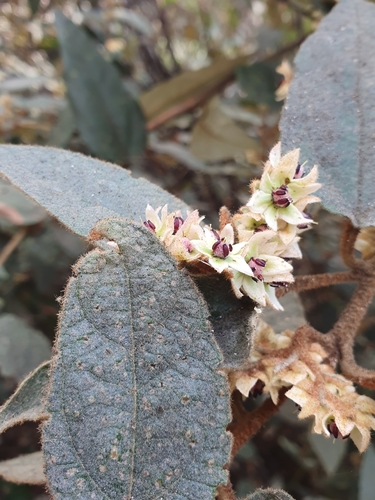
Lasiopetalum macrophyllum, commonly called shrubby velvet bush, is an erect or straggling, often untidy shrub. It typically grows 1–3 metres (3 ft 3 in – 9 ft 10 in) tall and up to 4 metres (13 ft) wide. Its leaves are egg-shaped to lance-shaped with a heart-shaped base, measuring 25–130 mm (0.98–5.12 in) long and 10–70 mm (0.39–2.76 in) wide, borne on a 5–20 mm (0.20–0.79 in) long petiole. The upper leaf surface is more or less glabrous, while the lower surface is covered in rust-coloured hairs. Flowers are arranged in crowded groups of six to twelve, and are covered with woolly, rust-coloured hairs. Lance-shaped bracteoles 5–6 mm (0.20–0.24 in) long grow below the base of the sepals. The petal-like sepals are cream-coloured and 6–8 mm (0.24–0.31 in) long, while the petals are reddish and less than 1 mm (0.039 in) long. Anthers are approximately 2 mm (0.079 in) long. Flowering occurs mainly from September to December. This species can be distinguished from the similar Lasiopetalum ferrugineum by the hairless inner surface of its sepals. Shrubby velvet bush grows in forest and woodland habitats, often growing among rocks and near watercourses. Its distribution includes the coast and tablelands of New South Wales, areas mainly east of Erica and the Grampians in Victoria, near-coastal areas of eastern and north-western Tasmania, and some Bass Strait islands. Lasiopetalum macrophyllum was introduced to cultivation in England in 1835. Its flushes of rust-coloured new growth have ornamental appeal, and it grows fairly readily in part-shade in gardens. It can be propagated by seed or cuttings, and forms selected for gardens have more attractive new growth and a prostrate habit. It grows well in well-drained soil in full sun or part shade, is frost tolerant, and is classified as somewhat fire retardant.