About Lasianthus chlorocarpus K.Schum.
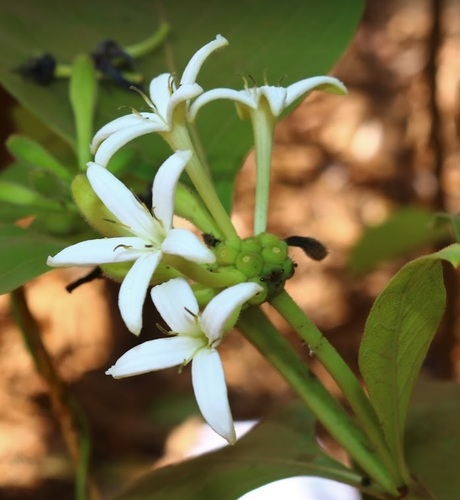
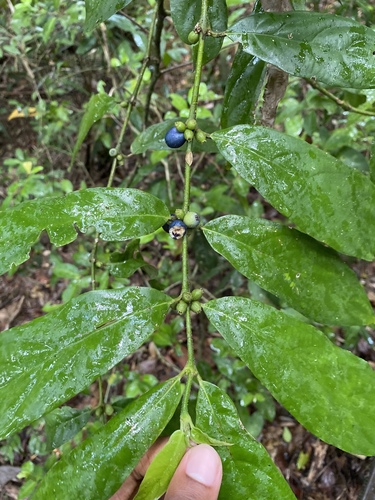
Lasianthus chlorocarpus K.Schum. is an understorey shrub that grows in rainforest habitats, reaching a maximum height of 2 m (6 ft 7 in). Its leaves are simple and arranged oppositely; they are hairless on the upper surface and finely hairy on the lower surface. The leaves are long and narrow, growing up to 19 cm (7.5 in) long by 5 cm (2.0 in) wide, with smooth margins. They have around eight pairs of lateral veins that curve strongly and run almost parallel to the leaf margin, but do not form loops with the next vein pair. Flowers grow from the leaf axils, are about 10 mm (0.39 in) in diameter, and have 4 or 5 white petals. The fruit is an ovoid drupe that grows up to 16 mm (0.63 in) long by 12 mm (0.47 in) wide. It is dark blue or blackish, with the persistent green calyx remaining at the apex. Fine hairs cover the fruit's outer surface, giving it a shiny appearance. Fruits usually contain four seeds, each measuring about 6 mm (0.24 in) long by 3 mm (0.12 in) wide. The natural range of this species, also called blue rubi, includes Sulawesi, the Lesser Sunda Islands, the Philippines, New Guinea, the Solomon Islands, and Queensland, Australia. In Queensland, it occurs in northeastern coastal forests: it is found in three small pockets in the northern half of Cape York Peninsula, and has a much larger distribution between Rossville and Tully. It grows in well-developed rainforest at altitudes ranging from sea level up to 500 m (1,600 ft). In Australia, flowering occurs almost year-round from April to February, and fruit ripen from February to December.