About Lascoria ambigualis Walker, 1866
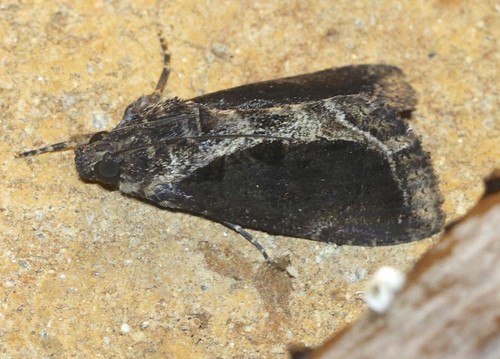
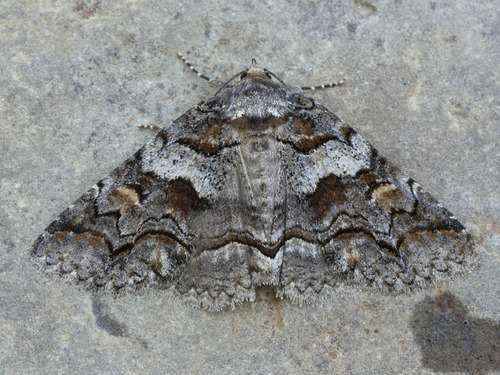
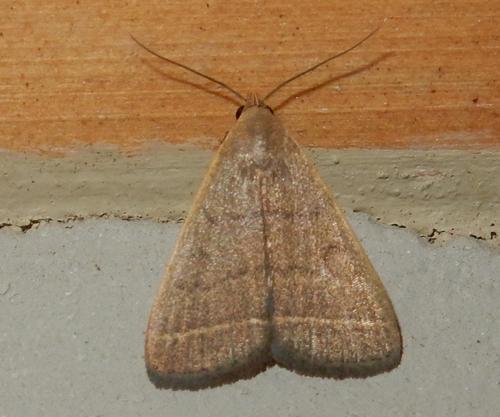
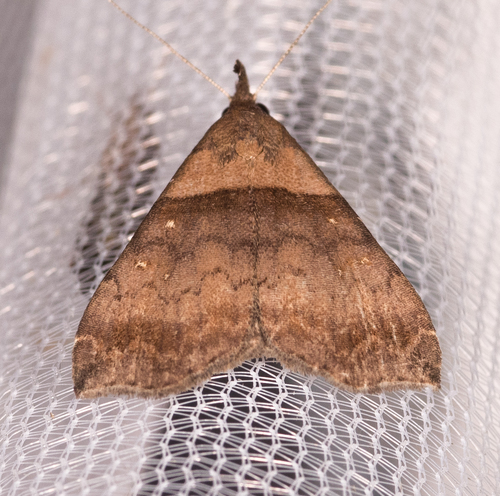
Lascoria ambigualis, commonly called the ambiguous moth, has a wingspan of 21–25 mm. When resting, it tucks its hindwings behind its forewings, which gives the moth a triangular shape. Individual moths vary slightly in coloration; their forewings can be brown, slightly purple, or various shades of gray. All individuals share a dark, straight band that runs across their wings. This band acts as a clear divider between the light-colored head and thoracic area and the darker lower portion of the wings. This species shows sexual dimorphism: males have a notch on the distal edge of the wing and a black spot at the head of the notch, and both of these features are absent in females. L. ambigualis is found in the United States from Wisconsin to Maine, and ranges south to Florida and Texas. It can live in a wide variety of habitats, but it is most commonly observed in shrubby fields, woodlands, and forests. The larvae of this species feed on Chrysanthemum species, as well as Aster, blackberry, and Verbesina. Larvae have also been reared on dead leaves.