About Larvivora sibilans Swinhoe, 1863
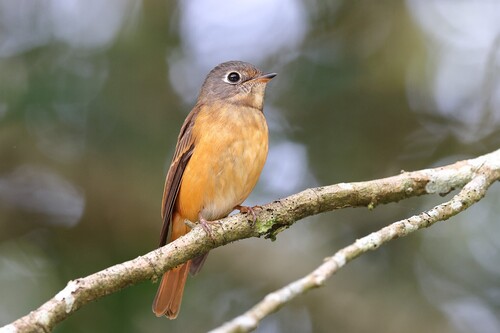
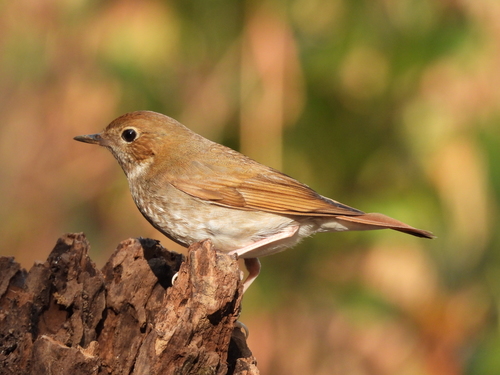
This species, commonly known as the rufous-tailed robin, has a scientific name of Larvivora sibilans Swinhoe, 1863. In terms of morphology, it measures 14 cm (5.5 in) long, matching the size of the European robin. Its upperparts are plain greyish brown, while underparts range from grey to white. Its throat and breast are heavily mottled, marked with circular pale spots. It has a bright rufous rump and tail, buff-colored flanks, a whitish eye ring, and a distinct buffish cheek stripe. The tip of its lower mandible is slightly upturned; the beak is brownish-black, and the legs are pinkish-grey. The sexes generally look similar, though females may be slightly paler. Juveniles resemble adults but have an ochre tinge, with dark edges on their upper plumage. At first glance, this bird can be mistaken for American Catharus thrushes such as the veery and hermit thrush. Male rufous-tailed robins sing during the day, and also sing at night during the breeding season. Their song is made up of several similar phrases: loud cascading trills that start at a high pitch and end lower, sounding similar to a horse’s neigh. Alarm calls are whistles, and parents with young produce a jangling "chok-chok" call. The rufous-tailed robin is a migratory, insectivorous species. It breeds in taiga forests across northeastern Asia, ranging south to Mongolia, and winters in southern China and Southeast Asia. It is a rare vagrant to Western Europe. The first European record of the species comes from Fair Isle, Scotland, in October 2004. A second individual was recorded in Poland in January 2006. More recently, sightings have occurred in Norfolk, England in October 2011 and again in September 2013, and in Denmark in October 2012. During the breeding season, it inhabits coniferous woodlands and damp broad-leafed woodland with fallen trees and thick undergrowth, especially stands of spruce and fir mixed with willow, alder, birch, poplar, and bird cherry. It is primarily a lowland species, but can sometimes be found at altitudes up to 1,200 m (4,000 ft) above sea level. In its winter range, it occurs in forests, areas with scattered trees, scrubland, parks, and gardens.