About Larsenaikia ochreata (F.Muell.) Tirveng.
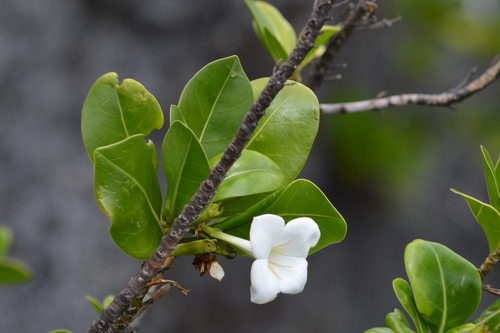
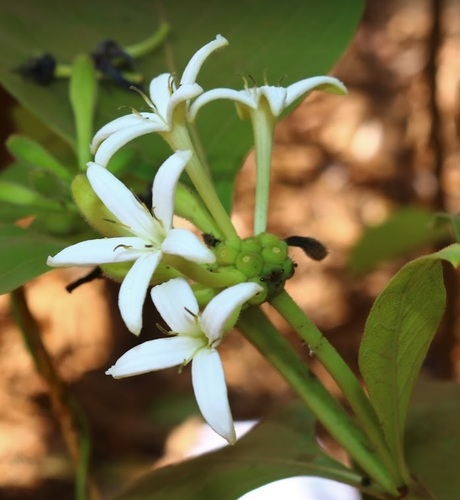
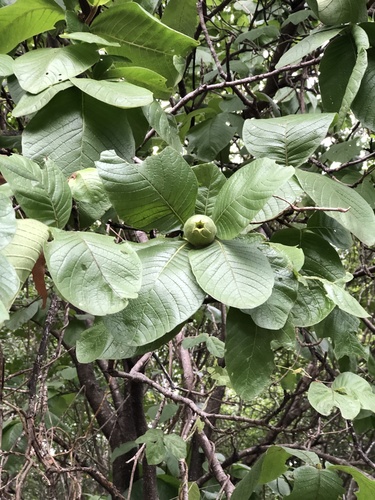
Larsenaikia ochreata (F.Muell.) Tirveng. is a tree that typically grows to around 15 meters in height, occasionally reaching up to 20 meters. Its stipules grow up to 12 mm long; when young, they fuse into a tube that encloses the leaf bud, then split along one side as the bud develops. The species' leaves vary in size and shape, but are most often broadly elliptic, measuring 8–25 cm long and 4–10 cm wide. Leaves are typically arranged in whorls of three on twigs, though they may also grow in opposite pairs, and have 8–12 quite prominent lateral veins on each side of the midrib. Inflorescences grow at the end of branches, and may be either single flowers, or cymes holding 2–4 flowers. The flowers are fragrant, and grow on pedicels up to 12 mm long. The green calyx tube is 5–8 mm long, with narrow linear lobes that reach up to 12 mm in length. The white corolla tube can grow up to 55 mm long with a diameter of 3–5 mm, and bears 5 or 6 lobes (petals) that measure up to 40 mm long and 13 mm wide. As flowers age, they turn yellow. The fruit of Larsenaikia ochreata is a drupe, which is yellow-green when mature, shaped ovoid to ellipsoid, and grows up to 50 mm long and 35 mm wide. The outside of the fruit is finely hairy, and the remains of the calyx lobes persist at the fruit's apex. The fruit rind is around 5 mm thick, and encloses a cream-colored placental mass that holds numerous seeds 3–6 mm long. Larsenaikia ochreata is widespread in eastern Queensland, Australia, and has been recorded from the tip of Cape York Peninsula southwards to Central Queensland. It grows in open forest and drier rainforest types including monsoon forest and vine thickets, at altitudes ranging from sea level to around 400 m.