About Larra bicolor Fabricius, 1804
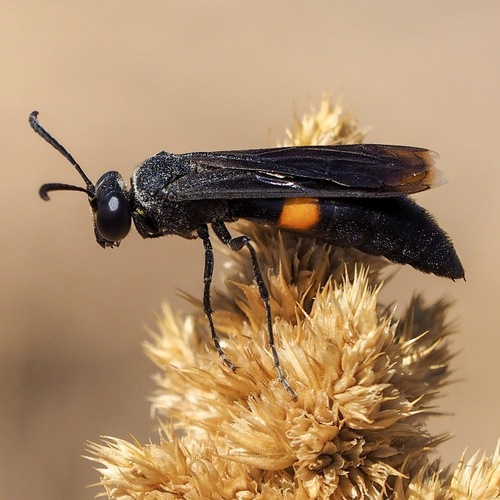
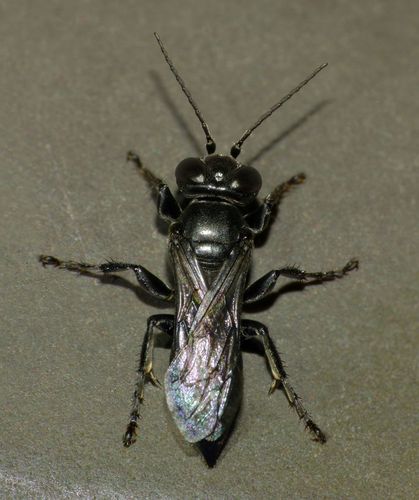
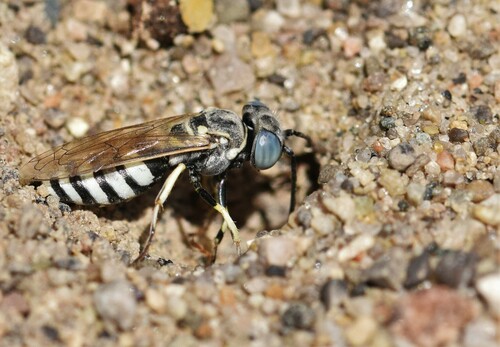
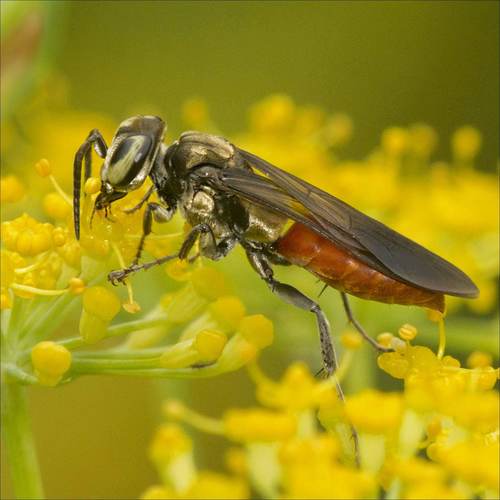
Description: Adult female Larra bicolor Fabricius, 1804 are roughly 22 mm long, while males are somewhat smaller. The head and thorax are black, with silver markings on the head, and the abdomen is red. Wing color is variable, with a generally dusky hue. Life cycle: Adult wasps of this species feed on nectar, and they prefer the shrub false buttonweed (Spermacoce verticillata). Females hunt mole crickets of the genus Scapteriscus, stinging them on the underside to paralyze them for several minutes. They lay a single egg between the host’s first and second pairs of legs, then fly away, and the paralyzed cricket returns to its burrow. Females will attack both nymph and adult crickets, as long as the host is large enough. After hatching, the wasp larva feeds on the host cricket, which eventually dies from the feeding. The larva pupates 12 to 30 days after hatching, with the timing dependent on temperature; it forms a cocoon inside the remains of the cricket by gluing sand grains together. The pupal stage can be as short as 50 days, but pupae may enter winter diapause that delays adult emergence for months. Adult Larra bicolor are solitary, and they do not form nests or colonies. Aside from the winter diapause noted above, no seasonal pattern to this wasp’s activity is known. There can be several generations of Larra bicolor per year; this trait lets the wasps reproduce more quickly than their hosts, which is an important characteristic for a successful biological control agent. Biological pest control use: Non-native mole crickets arrived in Puerto Rico no earlier than the 18th century, likely by flight, and reached the southeastern United States by 1899, probably as contaminants in ship ballast. These non-native crickets became serious pests that damage crops, pastures, and turfgrasses. While the related species Larra analis attacks the native northern mole cricket, it does not attack non-native mole cricket species. As an early example of biological pest control, L. bicolor was introduced to Puerto Rico in 1938 and successfully established a population there. This success suggested the species could be used for control on the United States mainland, but failed early attempts and the development of the pesticide chlordane in the 1940s ended these efforts. After chlordane use on food crops was banned in 1978, the Florida legislature launched a program at the University of Florida to find alternative controls for pest mole crickets. Limited budget led to repeating the introduction effort from Puerto Rico to the Florida mainland, but this Brazilian-origin population only successfully established in an area around Fort Lauderdale. Research indicated these wasps lacked sufficient cold tolerance, so a second introduction effort in 1988–1989 used wasps sourced from Bolivia. This introduction was far more successful; the wasps have gradually spread across most of Florida and into neighboring states. They remain highly adapted to non-native mole crickets and have not shifted to attack native species like the northern mole cricket. L. bicolor is also not aggressive, and its sting is reported to be mild compared to more widely known wasps. The main limitation to using this species as a biological control agent is the need to provide appropriate nectar sources for adult wasps. Some other plants, especially species in the genus Pentas, are also acceptable to the wasps, but providing suitable nectar plants is still necessary for successful use.