About Larinioides cornutus (Clerck, 1757)
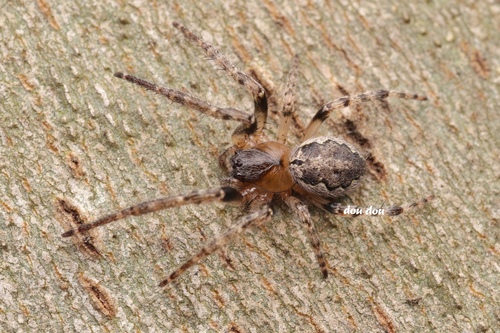
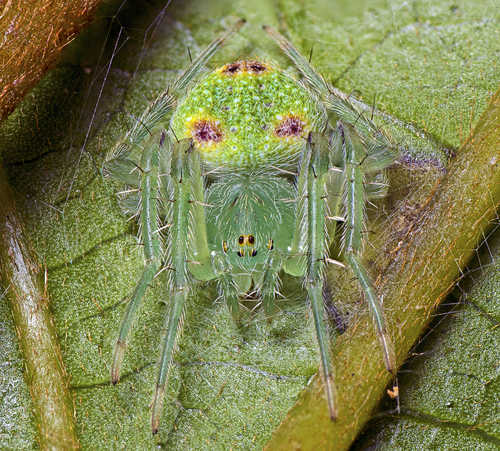
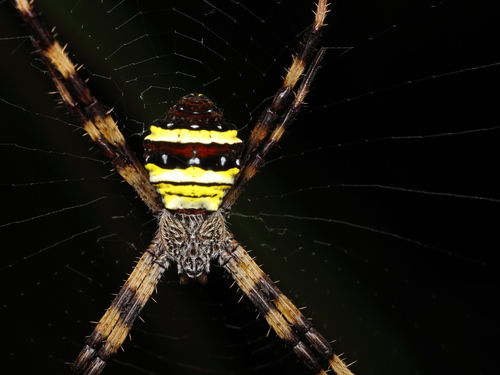
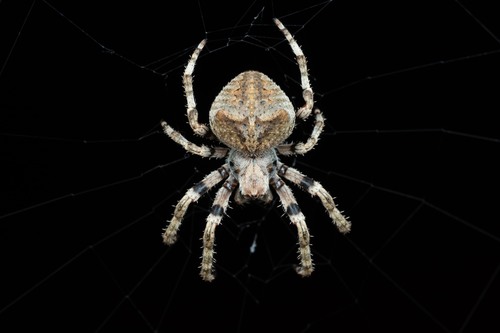
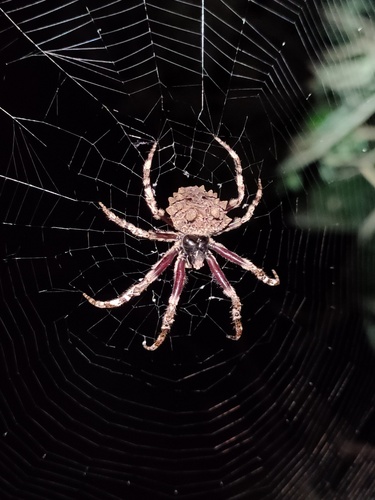
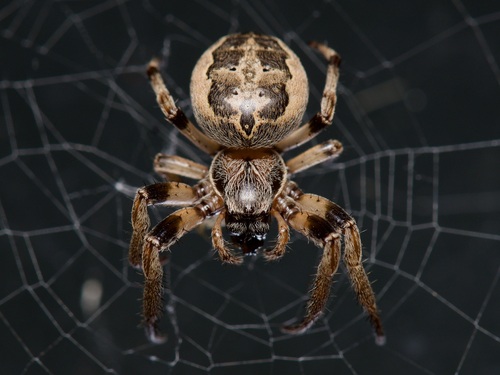
Physical description: Female Larinioides cornutus reach a body length of about 6–14 mm, while males reach a body length up to 5–9 mm. Leg spans for this species range from 18 to 35 mm. These spiders can be identified by their large, oval-shaped, bulbous abdomens. Their bodies can be black, grey, or various shades of red. The carapace near the abdomen almost always has a lighter-colored arrow that points toward the cephalothorax, and the legs feature a similar arrow pattern. Their eyes are arranged as a horizontal row of six eyes, with an additional pair positioned above the center of this row. A common misconception holds that spiders cannot hear because they lack ears and other common hearing structures; however, Larinioides cornutus can sense sound using macrosetae and filiform hairs located on their legs.
Habitat: These spiders are most often found in moist areas, especially near bodies of water. They build their webs between grass blades or in low shrubbery. During the day, they hide in a bottom-opening silken retreat masked with plant and animal matter, and they leave the retreat to forage during the night. They rebuild their web each evening. Unlike many other spider and animal species, Larinioides cornutus does not hibernate during winter; instead, it has an annual cycle of seasonal cold resistance. Its supercooling point is −8 °C in summer, and this drops to −20 °C in winter.
Reproduction: Similar to mating in many other spider species, female Larinioides cornutus create a silk cocoon for copulation. Females stay inside the cocoon and emit pheromones to lure males, who detect these pheromones through chemoreceptors. Males insert sperm using their pedipalps to fertilize the female's eggs, which then develop into yellow egg sacs. Like many other spider types, males typically die after mating, often being eaten by the female. The evolutionary purpose of this trait in spiders remains partially unknown. Males live with females during mating season, which occurs in both autumn and spring. Females produce three to five yellow egg sacs during the summer. There may be a distinct closely related species, Larinioides folium, which is very similar in appearance but lives in dry habitats.