About Lapsana communis L.
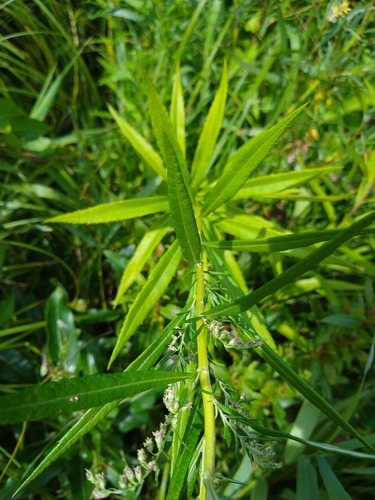
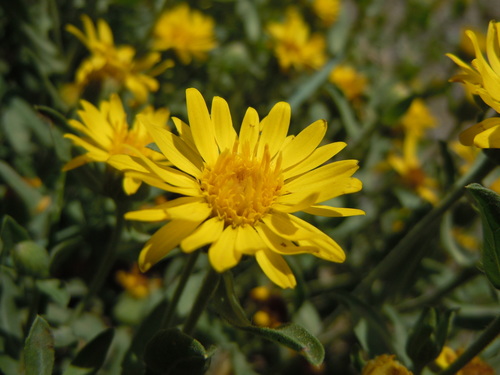
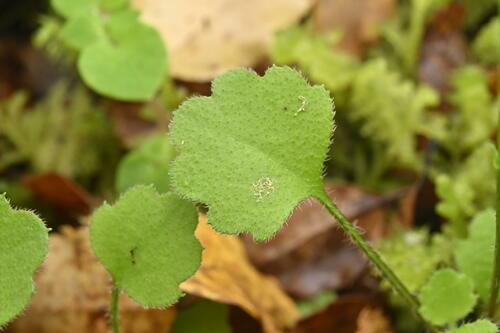
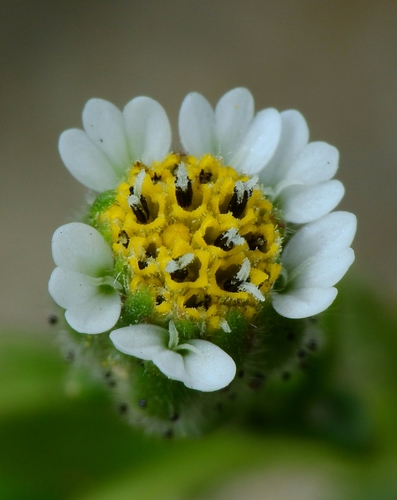
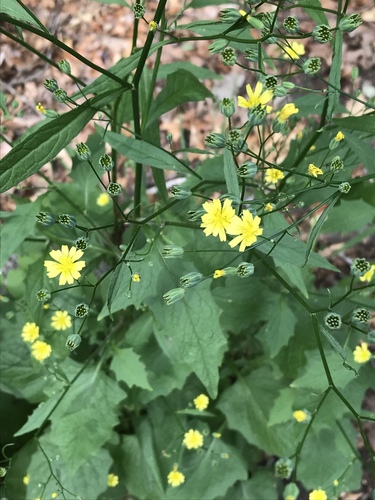
Lapsana communis L. is an annual or perennial herbaceous plant that reaches 1 to 1.2 meters (3 feet 3 inches to 3 feet 11 inches) in height. It has erect, hairy branching stems and milky sap. Its leaves are alternate and arranged in a spiral pattern. Larger leaves at the base of the flowering stem are often pinnate, featuring a large oval terminal leaflet plus one to four small side leaflets, while smaller leaves higher on the stem are simple and oval. All leaves have toothed margins. Yellow flowers form in capitula 1 to 2 centimeters (0.39 to 0.79 inches) in diameter; numerous capitula grow in loose clusters at the top of the stem. Each capitulum is surrounded by a whorl of involucral bracts, where outer bracts are very small and inner bracts are erect, narrow, stiff, and all the same length. All eight to fifteen florets are ligulate and pale yellow, shaped like a tongue with a five-toothed tip. Each floret has five stamens and a gynoecium made of two fused carpels. The fruit is a cypsela surrounded by the hardened remains of the involucral bracts. Numerous small seeds stay within the cypsela until the plant is shaken by wind or a passing animal. There is no pappus. Six accepted subspecies with their native ranges are: Lapsana communis subsp. adenophora (Boiss.) Rech.f. native to Southeast Europe; Lapsana communis subsp. alpina (Boiss. & Balansa) P.D.Sell. native to Crimea; Lapsana communis subsp. communis native to most of Europe except the southeast; Lapsana communis subsp. grandiflora (M. Bieb.) P.D.Sell. native to Southwest Asia; Lapsana communis subsp. intermedia (M. Bieb.) Hayek. native to Southwest Asia and southeast Europe; Lapsana communis subsp. pisidica (Boiss. & Heldr.) Rech.f. native to Greece. In areas outside its native range, Lapsana communis is common across the British Isles, naturalized across much of the world including Australia, Chile, New Zealand, Greenland, and most of Canada and the United States, and is sometimes considered an invasive species. It grows in arable fields, woods, hedges, hedgerows, roadsides, wasteland, woodland margins, and clear-felled areas within forests. Young leaves of this plant are edible, and can be used in salads or cooked like spinach. Due to the plant's tiny leaf hairs, some people prefer eating it mixed with other vegetables. Its scientific name derives from lapsane, an edible herb described by ancient Roman scholar Marcus Terentius Varro. Its common English name 'nipplewort' was coined in the 17th century as an equivalent to papillaris, the name used by German apothecaries, from the Latin papilla meaning nipple. The plant was historically used to treat cracked nipples and ulcerated breasts, particularly under the doctrine of signatures, because its flower buds resemble nipples.