About Lappula occidentalis (S.Watson) Greene
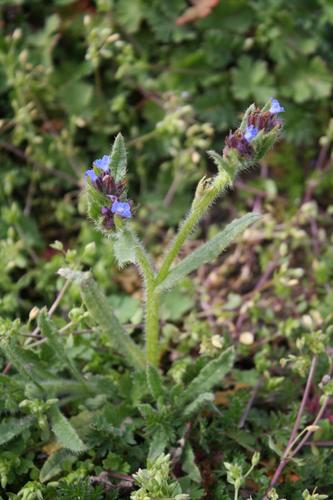
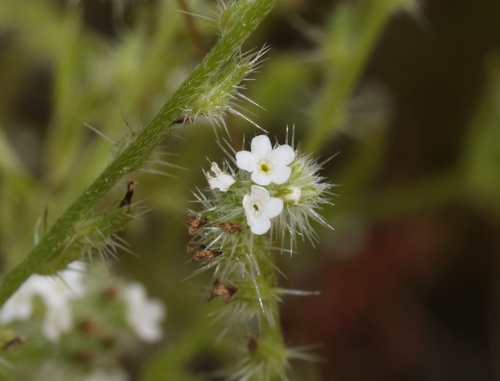
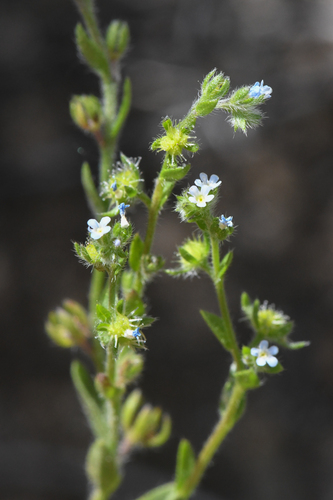
Lappula occidentalis, commonly called flatspine stickseed, is a flowering herb that reproduces via fruit. Its fruits split into four nutlets, with a single row of velcro-like prickles along the nutlet edges. The erect, angled stem is covered in fine hairs that can be appressed or spreading, reaches 5 to 40 cm tall, and may be simple or branched. Leaves are simple, alternately arranged with entire edges, and both basal and stem leaves are produced. Most basal leaves are oblong with a rounded tip, and they typically wither by the time the plant flowers. Stem leaves are narrowly lance-oblong, growing up to 2 inches long and around ¼ inch wide. They may lie flat or fold, are stalkless, pointed at the tip and rounded at the base, and decrease in size as they grow higher up the stem. Flowers of this species, also called flatspine sheepburr, are blue to purple and radially symmetrical, arranged in racemes that grow to 2 to 8 inches long as they mature. Each flower is around 1/8 of an inch in diameter, surrounded by five sepals that are fused near the base. Flowers alternate with bracts along the stem. Bracts, sepals, flower stalks, and leaves are all covered in similar fine hairs that range from appressed to spreading. Lappula occidentalis is native to North America and the polar regions of Europe and Asia. It grows in disturbed habitats including roadsides and railways. Because of the structure of its hooked fruit, animals like sheep can help spread this forb to habitats disturbed by livestock. The Navajo people used this species, also called Western stickseed, for ceremonial, gynecological, and dermatological purposes.