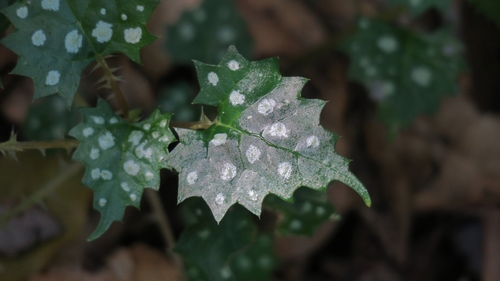
About Laportea grossa (E.Mey. ex Wedd.) Chew
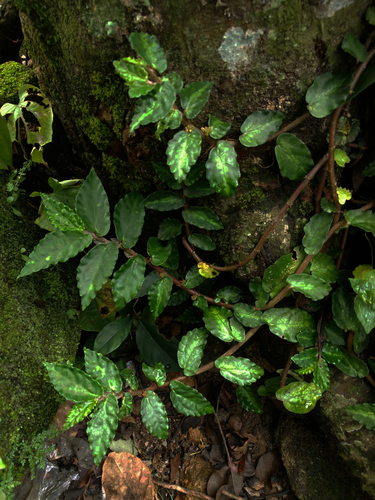
Laportea grossa, commonly known as spotted nettle, is an African plant species belonging to the nettle family Urticaceae. It is one of 31 recognized species in the genus Laportea. This species grows in shady habitats including coastal and escarpment forests, closed woodland, and streambanks. Its range extends from George in the Western Cape, through the Eastern Cape and KwaZulu-Natal, to southern Mozambique. The young leaves of Laportea grossa are cooked and consumed as a vegetable. It has decorative leaves marked by noticeable white spots, and the entire plant is covered in stinging hairs. It is a sprawling herbaceous plant that can grow as either a perennial or an annual, reaching approximately 1 meter in height. Its soft, erect stems are also covered in stinging hairs, and tend to root at the nodes, making the species easily propagated from cuttings. The leaves are arranged alternately, have a triangular shape with coarse teeth along the edges, and are also covered in stinging hairs. White spots on the leaves are not always present; when spots do occur, a stinging hair grows at the center of each spot. The lower surface of the leaf and the leaf stalk (petiole) are densely covered in stinging hairs. The stinging hairs are borne on slender protuberances, and contact with them causes a painful burning sting that can lead to localized redness of the skin. Laportea grossa is monoecious, meaning it produces both male and female flowers on the same individual plant. Small greenish flowers grow in panicles located in the axils of leaves. Male flowers are roughly 2 mm in diameter, have a regular shape, with 4 to 5 tepals and 5 stamens. Female flowers are 1.5 mm long, with 4 tepals of unequal size and a protruding white style. The species produces small, dry seeds approximately 1.7 mm long. Fruits, flowers, and leaves of Laportea grossa are eaten by three bird species: the Green Twinspot, Grey waxbill, and Common waxbill. The genus Laportea was named in honor of French naturalist François Louis de la Porte, comte de Castelnau.