About Laphamia emoryi (Torr.) Benth. & Hook.fil.
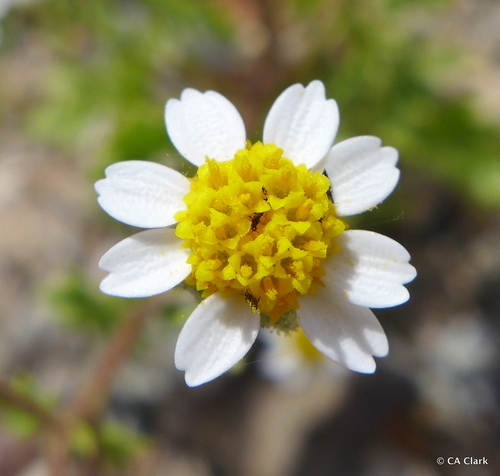
Laphamia emoryi (Torr.) Benth. & Hook.fil., also referenced as Perityle emoryi, is a polyploid plant species with substantial genetic and morphological variability. It is an annual herb that grows 2 to 60 centimeters tall. Its stems can be small, delicate, and unbranched, or thick, branching, and sprawling. The plant is generally hairy and glandular in texture. Its leaves are alternately arranged, grow on petioles, and have blades of variable shape that may be toothed or lobed. The inflorescence holds either a single flower head or a cluster of multiple heads. Each head is hemispherical to bell-shaped, usually less than one centimeter wide, with a central cluster of many golden disc florets surrounded by 8 to 12 white ray florets, each only a few millimeters long. The plant produces an achene fruit, which is often tipped with a pappus. This species has an amphitropical natural distribution across southwestern North America and western South America. In North America, it occurs throughout the deserts of Arizona, California, Baja California, Baja California Sur, Nevada, Utah, Sonora, and Sinaloa. In Southern California, it is rarely found in coastal regions and the Peninsular Ranges. It is widespread across nearly all ecosystems of the Baja California peninsula, except for the Cape region and higher mountains. It also grows on Guadalupe, an eastern Pacific island.