About Lapeirousia oreogena Schltr. ex Goldblatt
Lapeirousia oreogena Schltr. ex Goldblatt is a tuberous geophyte belonging to the iris family, Iridaceae. It was previously classified in subgenus Lapeirousia, the L. silenoides group of the genus Lapeirousia, but recent genetic analysis has placed it in Clade B, with its closest relative being Lapeirousia plicata. This perennial plant grows from a corm, lacks a stem, and reaches a maximum height of 10 centimetres (3.9 in). The Pacific Bulb Society describes it as a "striking species". It has linear to sword-shaped outer leaves and undulated inner leaves; overall the leaves are lanceolate, ribbed, and grow in tufts.
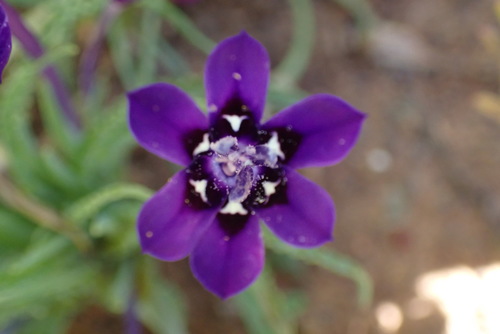
The flowers of L. oreogena are actinomorphic and star-shaped, unlike the common two-lipped flowers of the genus Lapeirousia. They are protandrous, meaning male sexual organs develop before female ones, and are scentless to the human nose. Flowers grow on an inflorescence at ground level, forming a spiralling spike on slender, undulating green bracts. The number of flowers per plant varies year to year; vigorous plants can produce up to five spikes, with up to 20 flowers per spike.
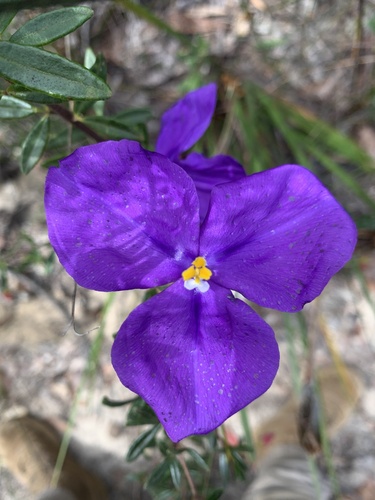
Flowers are violet, with black to dark purple blotches forming an inner ring at the base of the tepals. Six cream-coloured markings, shaped like isosceles triangles or arrowheads, point toward the opening of the corolla tube. These markings act as nectar guides to help pollinating flies successfully insert their proboscis during pollination. Flowers are 2 centimetres (0.79 in) in diameter, and have six slightly obovate tepals with rounded upper parts that curve slightly inward. At the base of the flower is a long perianth tube 4.5–6 centimetres (1.8–2.4 in) in length. Both the tepals and their nectar guide markings absorb UV light. Due to the flower's actinomorphic structure, the stamens and style are arranged symmetrically. Three stamens stand erect at the flower's centre; the oblong anthers are blue-purple in colour. The style has three branches, and the thinner style branches are slightly longer than the others.
While L. oreogena is able to set seed in greenhouses where insects are excluded, indicating partial autogamy, field studies show the species depends on pollinator visits to produce seed. Flowering occurs in late winter and early spring, from August to September. Flowers typically remain open for 3 to 5 days, and stigmas extend and open on days 2 to 3.
Lapeirousia oreogena has a fairly restricted distribution at the northern edge of South Africa's Cape Floristic Region, in the Northwestern Cape region, where it grows in clay soils. It occurs specifically in the Calvinia District, on the Bokkeveld Plateau, in the western Karoo, and around Nieuwoudtville. Its habitat is renosterveld on clay flats. In the Nieuwoudtville Wildflower Reserve, plants have been found growing in dense patches in open grassy areas between dolerite boulder outcrops.
This species follows the rhinomyophilous pollination syndrome, meaning it is pollinated by flies with long mouthparts. It is pollinated almost exclusively by a single species of Nemestrinid fly in the genus Prosoeca, a system described as one of the most specialized examples of coevolution among related plants; 28 other regional plant species have converged on this same pollination syndrome. The fly species was formally named in 2018 as Prosoeca marinusi, and it acts as the only or main pollinator for four plant species.
The flies hover to orient themselves before inserting their proboscis into the flower's perianth tube. Once the proboscis is inserted deep enough, the fly feeds while gripping the flower's tepals with all three pairs of legs by flexing its tibiae, and keeps its wings moving during the process. The fly is most active on mild, warm days between early and mid-afternoon, with a second flight period in the late afternoon. Flower visits last between 3 and 5 seconds, and pollen adheres to the fly's frons and thorax. This species is unique in placing pollen on the fly's frons and thorax; other Lapeirousia species deposit pollen on the fly's dorsum and upper frons.
To achieve the most efficient pollen transfer, flies must stop just short of reaching the nectar at the bottom of the tube. This has created an evolutionary arms race, where selection favours both longer flower tubes and longer proboscises in the fly, to help the fly reach nectar more efficiently.
In experiments by Dennis Hansen et al., researchers blotted out the flower's arrow-shaped nectar guides with black ink to match the reflectivity of the surrounding tepal base. Dye powder was used to simulate pollen dispersal. The experiments found that flies found the unmarked flowers at the same frequency as marked flowers, but without the arrow markings, pollinators could not successfully insert their proboscis. Only 5 out of 64 tested flies (7.8%) succeeded in proboscis insertion. Without arrow markings, only 1 out of 20 unmarked flowers exported dye grains, compared to 11 out of 21 flowers that retained their markings. Fruit set was 17 out of 29 for unmarked female flowers, and 9 out of 34 for marked female flowers, a significant difference. The results confirm a causal link between nectar guides and plant fitness for both male and female reproductive components in a natural setting. Long-distance attraction of pollinators is not significantly impacted by the absence of nectar guides, but once attracted to guide-less flowers, flies hover above the corolla or attempt to probe the flower without being able to successfully enter. The UV absorption of the L. oreogena nectar guides also contradicts the common idea that nectar guides create reflective contrast in the UV spectrum.