About Lanmaoa fragrans (Vittad.) Vizzini, Gelardi & Simonini
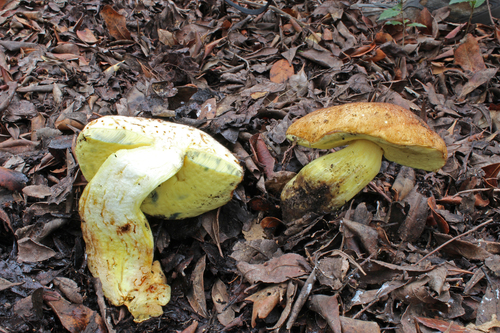
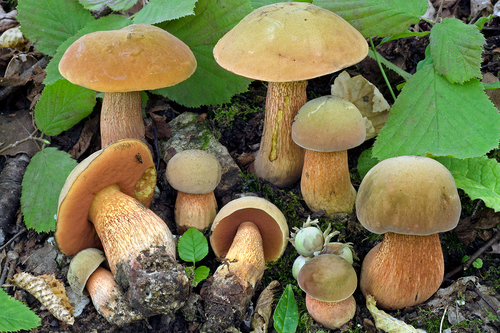
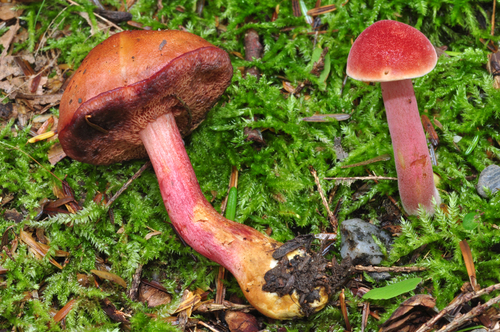
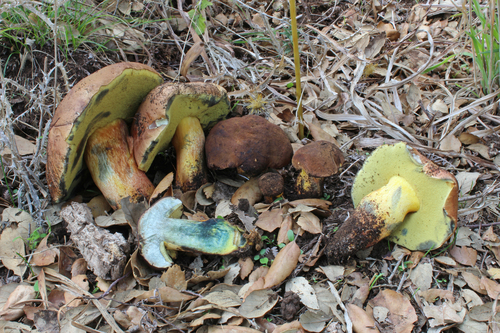
Lanmaoa fragrans is a rare bolete fungus species belonging to the family Boletaceae, found in Europe. Its cap is brownish and convex, with a diameter ranging from 5–12 cm (2.0–4.7 in). The cap initially has a velvety texture, which becomes smooth as it matures. The stipe is spindle-shaped, measuring 7–9 cm (2.8–3.5 in) long and 3–5 cm (1.2–2.0 in) wide. The stipe is yellow at the top, flushed with red in its lower sections, and ends in black at the very base. The yellow flesh of the fungus is tinged with red under the cap cuticle. It only bruises blue after several hours of exposure to air. The pores on the underside of the cap are lemon-yellow to chrome-yellow, and show a faint blue bruising reaction. Its spores are elliptical, measuring 9–14 by 4.5–6.5 μm, and a mass of spores produces an olive-green spore print. Lanmaoa fragrans is most frequently reported from southern Europe, where it forms mycorrhizal associations with oaks. This fungus is edible, with a pleasant taste and aroma. While Lanmaoa fragrans has occasionally been reported from North America, the North American population associates with conifers instead of oaks, and it has not been confirmed that it is the same species as the European Lanmaoa fragrans. This fungus was originally described in 1835 by Italian mycologist Carlo Vittadini as a species of Boletus, and was transferred to the genus Lanmaoa in 2015 by Alfredo Vizzini.