About Langloisia setosissima (Torr. & A.Gray) Greene
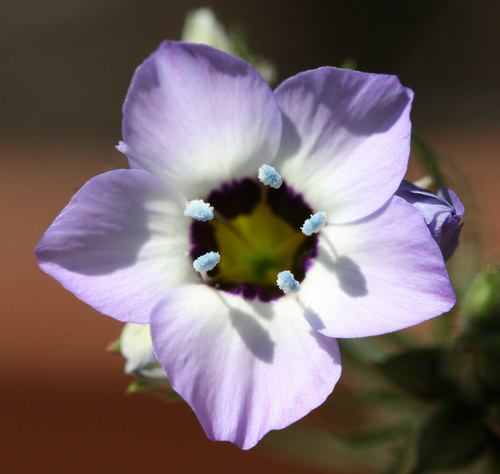
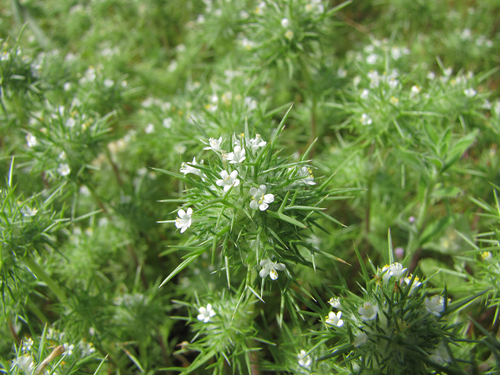
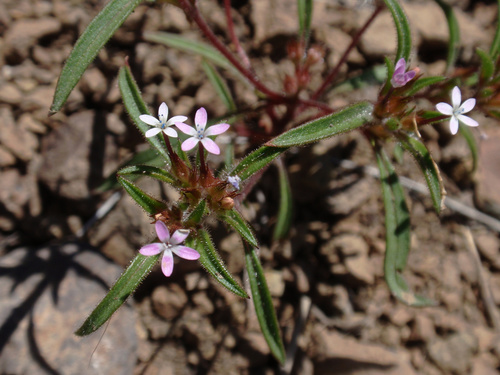
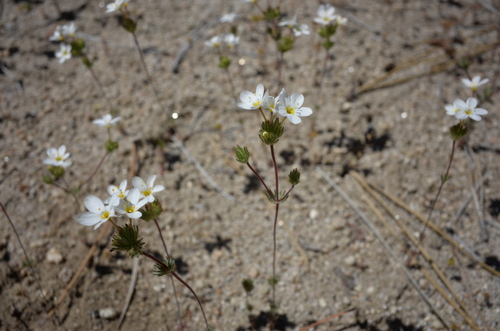
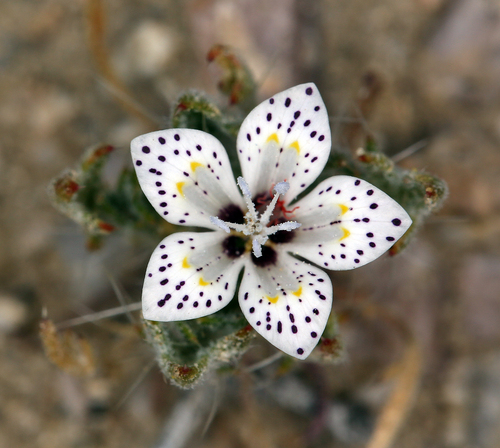
Langloisia is a monotypic genus of flowering plants in the family Polemoniaceae, containing only the single species Langloisia setosissima. This species goes by a number of common names: bristly langloisia, bristly-calico, Great Basin langloisia, and lilac sunbonnets. The genus name Langloisia honors Auguste Berthélemy Langlois (1832–1900), a French-born American clergyman and botanist. Langloisia setosissima is native to the western United States and northwestern Mexico, where it grows in desert washes, rocky slopes, and plains. Its range extends from eastern Oregon and Idaho south through Nevada and Utah to eastern California and Arizona. It is an annual plant that reaches 4 to 20 centimeters in height. Its leaves are spirally arranged, linear, 2 to 3 centimeters long, densely bristly, and have toothed margins. The flowers measure 1.5 to 2 centimeters across, range in color from white to light blue or pale purple, and have a deeply five-lobed corolla. The species is divided into two subspecies. Langloisia setosissima subsp. setosissima has uniformly colored corollas that may show faint patterns of dots and stripes. Langloisia setosissima subsp. punctata, which has the synonyms Langloisia lanata and Langloisia punctata, has corollas spotted with darker purple and yellow. The genus Loeseliastrum was previously classified within Langloisia. It was split off from Langloisia to accommodate two former species of the genus: Loeseliastrum matthewsii, previously known as Langloisia matthewsii, and Loeseliastrum schottii, previously known as Langloisia schottii.