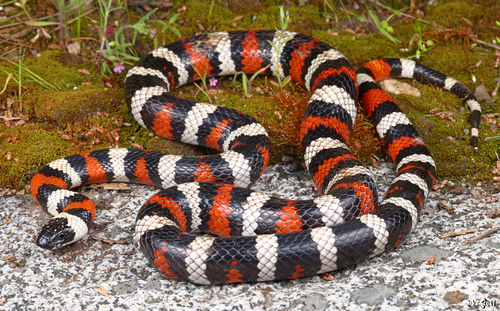
About Lampropeltis zonata (Lockington, 1835)
California mountain kingsnakes, scientifically known as Lampropeltis zonata (Lockington, 1835), have a banded pattern of red, black, and white crossbands. The bands always follow the same arrangement: each red crossband is surrounded by two black crossbands, forming a unit called a triad. Each triad is separated from the next by a white crossband, and occasionally by a cream or yellow crossband instead. Some individual snakes have lower amounts of red pigment, and rare individuals have almost no red bands at all. One population from Isla Todos Santos consistently lacks red crossbands, and instead has uniform black and white banding, making it look similar to the closely related California kingsnake. The California mountain kingsnake is endemic to western North America. Its geographic range extends from a disjunct population in extreme southern Washington state, through Oregon and California, to northern Baja California. Most of this species’ range falls within the state of California, which is how it got its common name. As its common name implies, the California mountain kingsnake occurs mostly in the mountains throughout its geographic range.