About Lampropeltis triangulum (Lacépède, 1789)
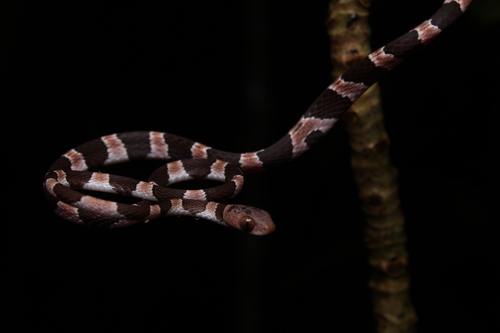
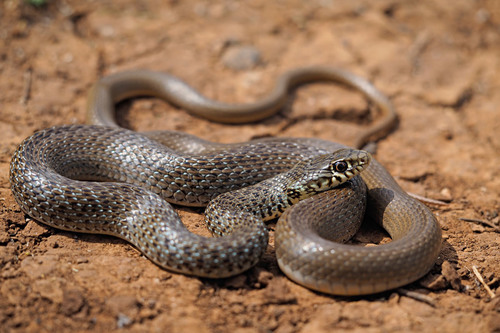
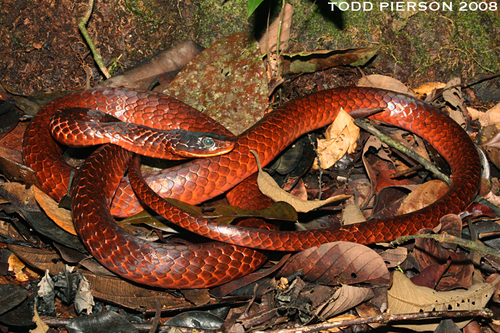
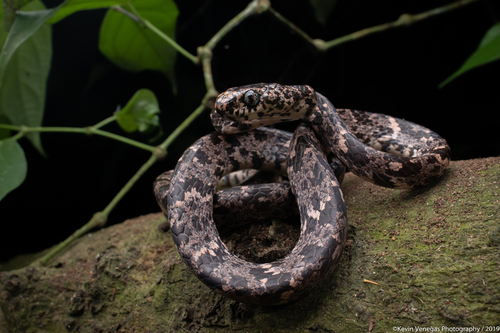
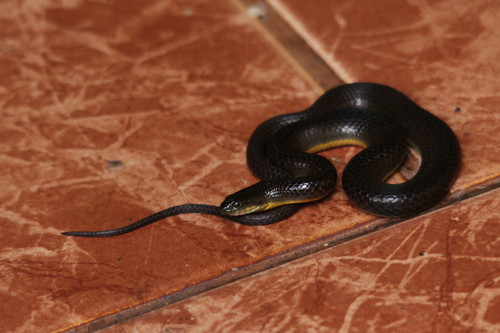
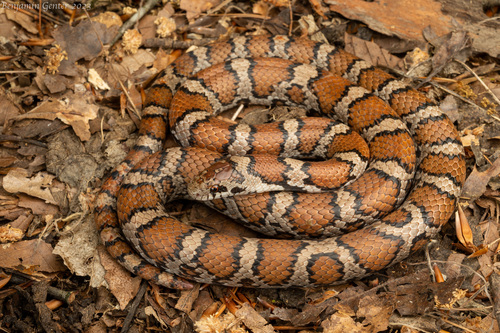
Milk snakes (Lampropeltis triangulum) show substantial size variation across their different subspecies. Fully grown individuals range from as small as 14 inches (36 cm) to as large as 72 inches (180 cm) in total length. Wild adult milk snakes in North America average between 38 grams (1.3 oz) and 225 grams (7.9 oz), while unusually large specimens can weigh 750 to 1,400 grams (1.65 to 3.09 lb); these very high weights are most often reported from captive individuals. Mature males are typically larger than females, though females of the same length as males can be more bulky. In general, adult milk snakes from tropical populations in Mexico and areas further south grow to larger sizes than those from temperate zones. Milk snakes have smooth, shiny scales, and their most common color pattern consists of alternating bands of red-black-yellow or white-black-red. Some populations have red blotches instead of bands. Many milk snakes closely resemble venomous coral snakes, a form of Batesian mimicry that likely deters potential predators. Both milk snakes and coral snakes have transverse bands of red, black, and yellow. Popular mnemonics used to tell deadly coral snakes apart from harmless milk snakes are now recognized by experts as not 100% reliable, because some coral snakes do not have the expected banding colors or patterns. Common examples of these unreliable mnemonics include: "Red on yellow kills a fellow. Red on black, venom they lack"; "Red touches black, it's a friend of Jack. Red touches yellow, it's bad for a fellow"; "Red, yellow, black... stay well back. Red, black, yellow... they're a friendly fellow." Due to its wide range of color variations, the eastern milk snake (L. t. triangulum) can resemble coral snakes, corn snakes, fox snakes, scarlet snakes, and most notably the venomous snake genera Agkistrodon and Sistrurus. Milk snakes, fox snakes, and scarlet snakes are often killed because they resemble venomous pygmy rattlers. Juvenile milk snakes, which are more reddish than adults, are frequently killed after being mistaken for copperheads. There is enough visible difference between the five similar species to make eastern milk snakes fairly easy to identify. Eastern milk snakes also have a light-colored V-shaped or Y-shaped patch on their necks. One subspecies, L. t. gaigeae, is melanistic, meaning it is almost entirely black when adult. The geographic range of milk snakes extends from the southeasternmost part of Ontario, Canada, into southeastern Maine and all Eastern Seaboard states of the United States, south to Florida, Alabama, and Mississippi. In the U.S. Midwest, they are found from central Minnesota to Colorado, Nebraska, and the Dakotas. They also occur in the foothills of the Appalachian Mountains, as well as in Georgia, Tennessee, Kentucky, Arkansas, Missouri, Kansas, Oklahoma, Texas and Louisiana. Additional subspecies are found across nearly all of Mexico, from the state of Sonora east to the Gulf coast of Tamaulipas, throughout central and southern Mexico, across all of Central America, and into Colombia and Ecuador. Across its broad distribution, milk snakes occupy a wide variety of habitats. They most commonly prefer forested regions or open woodland, but can also be found in swamps, prairies, farmland, rocky slopes, some semi-arid/chaparral areas, and sand dunes or beaches. In some areas, milk snakes migrate seasonally: they often move to higher, drier habitats to hibernate during winter, and return to moister habitats for the summer. Human-caused habitat destruction and fragmentation often limits this seasonal migration. Depending on subspecies, milk snakes hibernate from late October or November to mid-April. Milk snakes are oviparous, with females laying an average of around 10 eggs per clutch, though clutch size can vary by region. Mating occurs from early May to late June. Females lay between three and 24 eggs in June and July, placing the clutch beneath logs, boards, rocks, and rotting vegetation. The eggs are oval, white, and measure 2.5 to 4.2 cm (0.98 to 1.65 in) in length. Eggs incubate for around two months and hatch around August or September. The average hatchling measured in Virginia has a total length of 20.9 cm (8.2 in) and weighs 4.1 g (0.14 oz). Milk snakes typically live around 12 years in the wild, and can live up to 21 years in captivity. They reach sexual maturity within three to four years.