About Lampropeltis getula (Linnaeus, 1766)
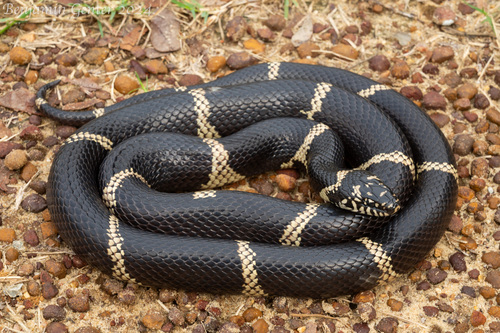
Description: For the common kingsnake, Lampropeltis getula, adult subspecies differ in average size. Adult speckled kingsnakes (Lampropeltis getula holbrooki) are the smallest subspecies, with an average snout-to-vent length (SVL) of 91.5 cm (36.0 in). The nominate subspecies L. g. getula is the largest, with an average SVL of 107 cm (42 in). The maximum recorded total length (including the tail) for the species is 208.2 cm (82.0 in). Body weight ranges from 285 g (10.1 oz) for a small specimen 87.2 cm (34.3 in) in total length, up to 2,268 g (80.0 oz) for large specimens over 153 cm (60 in) in total length. The species has a glossy base color that can be black, blue-black, or dark brown, overlaid with 23 to 52 white chain-like rings. Pattern variation occurs across different geographic ranges: kingsnakes from coastal plains have wider bands, while individuals from mountainous areas have thinner bands, or may be entirely solid black. Geographic range: Lampropeltis getula occurs in the southeastern United States, ranging from southern New Jersey south to Florida. Habitat: Preferred habitats for Lampropeltis getula are open areas, especially grassland. It can also be found in chaparral, oak woodland, abandoned farms, desert, low mountains, sandy areas, and all types of riparian zones including swamps, canals, and streams. One study of eastern kingsnake habitat use found that the species generally prefers and occupies sites with a thick layer of leaf litter and dense shrubbery. Observations of tracked individuals found that 79% of specimens spent most of their time concealed under soil and leaf litter cover. While the species is commonly described as diurnal, some reports note that eastern kingsnakes are crepuscular or nocturnal during the hottest parts of the year. They often retreat into rodent burrows to shelter for the night. Home ranges of eastern kingsnakes typically show little to no overlap between individuals. Some studies indicate that the eastern kingsnake (L. g. getula) is territorial, especially males; when an intruding snake enters their territory, males will engage in combat to defend it. Reproduction: Lampropeltis getula is oviparous. Adult females can lay up to several dozen eggs, which hatch after an incubation period of 2.0 to 2.5 months. Hatchlings are brightly colored, and feed on small snakes, lizards, and rodents. Across most of its range, the eastern kingsnake (L. g. getula) is active from April to October, with breeding taking place in the spring. Neck-biting is a common mating behavior for the species.