About Lampropeltis californiae (Blainville, 1835)
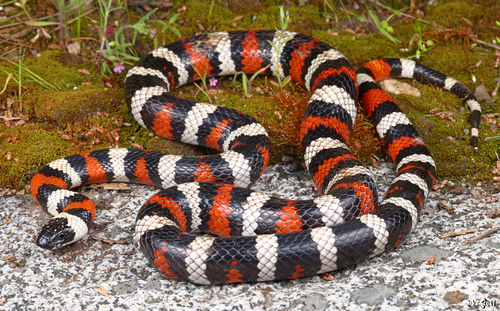
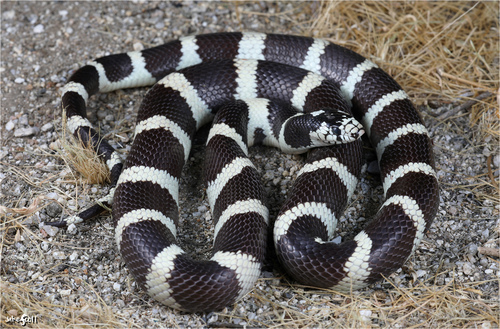
Description: Wild California kingsnakes (Lampropeltis californiae) are typically 2.5–3.5 feet (76–107 cm) long, though they can grow larger. Individuals on Isla Ángel de la Guarda, Baja California, Mexico, have been recorded reaching 78 inches (2 m). A wide variety of color morphs occur in wild populations. Most wild individuals have alternating dark and light bands, with color combinations ranging from black and white to brown and cream. Some populations have longitudinal stripes instead of bands. Most wild California kingsnakes live 10 to 15 years; well-cared for captive individuals can live over 20 years. The species' striped or banded patterns are critical for survival, as they act as camouflage to hide the snake from predators. Known predators of California kingsnakes include hawks, eagles, coyotes, skunks, foxes, bobcats, and other kingsnakes. Range and habitat: The California kingsnake is widespread along the West Coast of North America, occurring up to around 6,100 ft (1,900 m) elevation in the Tehachapi Mountains, and over 7,000 ft (2,100 m) in the southeastern Sierra Nevada Mountains. This species occupies a wide range of habitats, including woodland chaparral, grassland, deserts, marshes, and even suburban areas. Its native range covers Oregon, California, Nevada, Utah, Arizona, southwestern Colorado, northwestern New Mexico, and northwestern Mexico. California kingsnakes thrive at temperatures between 80–84 °F with humidity around 35–60%. Optimal conditions vary based on the snake's biological state: for example, they prefer warmer temperatures during reproduction, and higher humidity when shedding. In Arizona, this species intergrades with the desert kingsnake (Lampropeltis splendida) and the Mexican black kingsnake (Lampropeltis getula nigrita). The California kingsnake has also become invasive on the Spanish island of Gran Canaria, where the population reached an estimated 20,000 individuals in 2014. Reproduction: The California kingsnake is an oviparous species with internal fertilization, meaning it lays eggs rather than giving birth to live young like some other snakes. Courtship begins in the spring, usually after the snakes finish hibernation or complete their first shedding of the season. Males compete for available females: when fighting another male, a California kingsnake will climb onto the rival male and bite it to assert dominance. Mating begins when the male vibrates uncontrollably. Females lay eggs between May and August, typically 42–63 days after mating. Before laying, the female selects a suitable nesting site. Clutch size is usually 5 to 12 eggs, with an average of 9, though clutches of 20 or more eggs have been documented. Hatchlings emerge 40–65 days after laying, and measure approximately 8 to 13 inches long. Newly hatched kingsnakes remain in the nest for around one week, then shed their first skin before leaving the nest. Most adult California kingsnakes are 2.5–3.5 feet long, and rarely exceed four feet.