About Lamprocapnos spectabilis (L.) Fukuhara
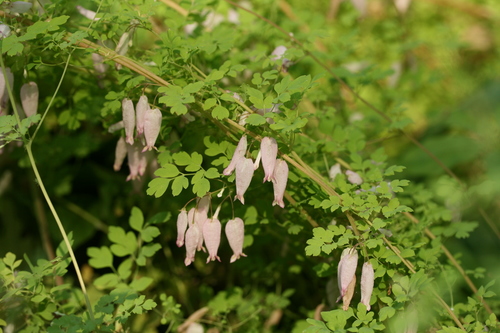
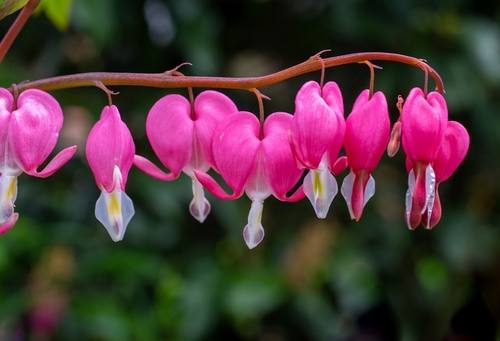
Lamprocapnos spectabilis, commonly called Asian bleeding-heart, grows up to 120 cm tall and 45 cm wide. It is a rhizomatous herbaceous perennial, with 3-lobed compound leaves growing on fleshy stems that range from green to pink. In spring and early summer, it produces arching horizontal racemes that hold up to 20 hanging flowers. The outer petals of these flowers are bright fuchsia-pink, and the inner petals are white. The flower shape strikingly resembles a traditional heart with a small droplet hanging beneath it, which gives the plant its common name. This species sometimes acts as a spring ephemeral, going dormant during the summer months. In Korea, L. spectabilis grows as a shade-loving chasmophyte, found in rock crevices at low altitudes in the mountains of central and southern parts of the country. Lamprocapnos spectabilis is native to Northeast Asia, specifically Northeast China (the provinces of Liaoning, Jilin, and Heilongjiang) and the Korean peninsula. However, this species has been cultivated as an ornamental plant in this region for so long that it is difficult to determine exactly which areas are its native range and which are areas where it has been introduced. This plant contains isoquinoline alkaloids including protopine. Contact with the plant can cause skin irritation in some people, while eating its leaves can lead to neurological symptoms such as confusion and irritability. In 2015, Jeong et al. reported a non-fatal poisoning case in Korea: four people dining at a local restaurant developed symptoms of varying severity after eating a dish of crucian carp and Korean radish greens. A possibly careless or inexperienced chef had added L. spectabilis leaves to the dish, likely mistaking them for radish leaves when gathering wild edible herbs to cook with the fish. The researchers noted that poisoning severity correlated with the amount of the contaminated dish the person ate. Only one person, a middle-aged man already in poor health who had eaten the largest portion, required hospitalization. All four poisoned people reported lethargy, dizziness, palpitation, and dry mouth half an hour after eating the meal. The authors concluded that the clinical manifestations of this poisoning case indicate anticholinergic syndrome. They speculate that the mental changes experienced by the victims were caused by central nervous system effects of two alkaloids: scoulerine, which can act as a GABAA receptor agonist, and corydine, which can produce narcotic effects. They also note that the neurological effects of the alkaloid protopine are qualitatively similar to those of atropine, the well-known delirient tropane alkaloid. The 45-year-old man admitted to the accident and emergency department had pre-existing hypertension and chronic kidney disease. He arrived with confused mental state, elevated blood pressure, tachycardia, mild fever, dry mouth, and facial flushing. A neurological examination found his confusion was intermittent, paired with irritability and an inability to understand and follow commands. His motor function was normal, he showed no abnormal reflexes, his pupils were of equal size (not anisochoric), and unlike in atropine poisoning, his pupils remained responsive to light. His mental state began returning to normal 19 hours after admission, though intermittent confusion persisted. He finally regained normal, alert mentation 28 hours after admission. For cultivation, this plant grows in full sun in cool, moist climates, but needs partial shade in warmer, drier climates. Aphids, slugs, and snails sometimes feed on its leaves. Clumps of this plant stay compact for many years and do not require dividing. It has brittle roots that are easily damaged when disturbed, so root cuttings should be taken in spring. It produces seeds with whitish elaiosomes contained in long pods, and these seeds must be sown while they are still fresh. If division is done, it should be carried out in late autumn or early spring. In Chinese culture, there is a traditional poem by Wang Wenying from *Poems of a Hundred Flowers* (number 70, titled Purse Peony) that tells a legend of a pining maiden associated with the plant: "Delicate and quaint, with pendent drop of yearning unashamed / Bright as rosy clouds of eventide. / 'Tis said that, long ago, near ancient Luoyang town, / There dwelt a jade-bright maiden, wise and pure, / Whose secret love was called away to war, / Each month a wondrous purse embroidered she to hang upon the bough, / Drawstring pulled tight upon sweet fragrance pent within. / Pity the girl who pictured daily thus her pining heart." In Traditional Chinese medicine, the root of this plant is used for detoxification, to improve blood circulation, and as an analgesic. The 1949 text *Lingnan Medicine Collection* records that Lamprocapnos root can disperse blood, eliminate sores, eliminate "wind" (fēng), and harmonize the blood. The medicinal properties of the root are described as pungent, bitter, and warm, and it is believed to replenish jing in the liver. Oral administration is used to treat sores and abdominal pain, while topical application is used to treat bruises and swellings. Caution is advised regarding overdose: the plant's juice can cause tingling paresthesias after contact with exposed skin. Oral overdose can lead to vomiting and diarrhea, and in severe poisoning cases, it can even cause respiratory failure and cardiac paralysis.