About Lampornis hemileucus (Salvin, 1865)
Taxonomy and Nomenclature
The white-bellied mountaingem, scientifically named Lampornis hemileucus (Salvin, 1865), measures 10 to 11 cm (3.9 to 4.3 in) long.
Body Size and Weight
Males weigh approximately 6.2 g (0.22 oz), while females weigh 5.1 g (0.18 oz).
Shared Physical Traits
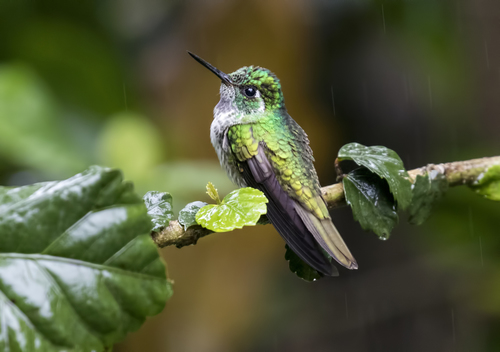
Both sexes share the same physical traits: a medium-length black bill, a long white stripe behind the eye, and pinkish feet.
Adult Male Head Coloration
For adult males, the face and crown are glittering green.
Adult Male Upperparts Coloration
Most of the rest of the upperparts are bronzy green, and the uppertail coverts are bronzy.
Adult Male Tail Structure
The tail is also bronzy, with dusky gray bands near the end of the outer feathers.
Adult Male Underparts Coloration
Adult males have a blue-violet gorget, and the rest of their underparts are white with green speckles along the sides.
Adult Female Plumage Differences
Adult females are similar in appearance to males, but their face and crown are less glittering, and their throat is white with green speckles.
Juvenile Plumage Traits
Juveniles of both sexes have rusty fringes on their green feathers; juvenile males have a dull bronze gorget.
Caribbean Slope Distribution
The white-bellied mountaingem is distributed on the Caribbean slope from north-central Costa Rica, extending south and east into western Panama as far as Veraguas Province.
Pacific Slope Distribution
It also occurs locally on the Pacific slope in Panama.
Primary Forest Habitat
This species inhabits the canopy of cool, very wet subtropical forest.
Edge and Gap Habitat
It can also be found at the shrub level at forest edges, and within forest gaps and clearings.
Avoided Habitats
It mostly avoids secondary forest and other semi-open landscapes.