About Lampides boeticus (Linnaeus, 1767)
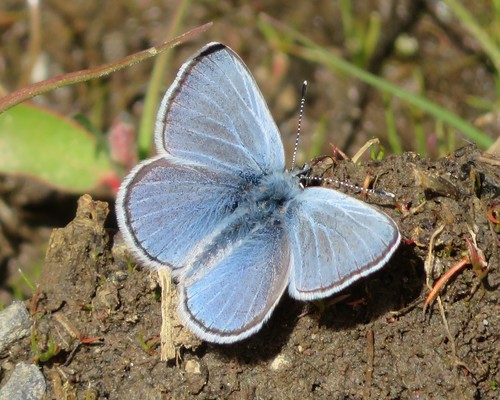
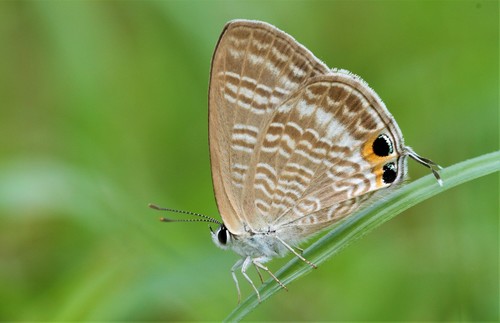
Lampides boeticus (Linnaeus, 1767) is a small butterfly species, though it is unusually large for its family. Males have a wingspan of 24–32 mm, while females have a wingspan of 24–34 mm. This species exhibits clear sexual dimorphism in the upperside of the wings: males are mainly violet-blue with brown edges, while females only have a small amount of blue colour in the centre of the wings. Both sexes have a thin, long tail on the hindwings and two black spots in the anal angle. The underside of the wings is ochre with white markings and a larger white submarginal streak. The underside of each hindwing has a pair of small black eye-spots beside each tail, with orange marginal spots at the anal angle. This species is similar in appearance to Leptotes pirithous and Cacyreus marshalli, but can be distinguished by being significantly larger than both. For males, the upperside is violet-blue, with hair-like whitish scales scattered across the entire surface of both wings. The forewing has a brown line along the costa and outer margin; the outer marginal line often has a slight inward brown suffusion. The hindwing has a similar marginal line, a fairly large round black subterminal spot in interspace 2, and a smaller spot in interspace 1. Each spot is ringed, sometimes with pale blue, and sometimes with pale orange-ochreous. Cilia are white with a brown basal band; the tail is black and tipped with white. The underside is grey with a slight ochreous tinge, and markings are brownish. The forewing has a pair of bars across the middle of the cell, a pair across the end of the cell, and a pair in the disc extending from near the costa to vein 3, continuing slightly inward to the hinder margin in two pieces; all pairs of bars have white on the inner side. The hindwing has eight or nine more or less sinuous brown fasciae spaced evenly apart, with white marks between all the brown lines. Both wings have a brown terminal line, a white subterminal line, then a series of white lunules followed by white marks. These marks are arranged more or less in echelon on the forewing, and form a narrow white band on the hindwing. All markings on both wings are spaced evenly across the surface. Small jet black subterminal spots that contain metallic blue-green scales and are broadly surrounded by orange are present in interspaces 1 and 2. For females, the upperside has some slight brownish suffusion, with shining blue scales at the base of both wings and in the inner portion of the forewing. The hindwing has two spots in interspaces 1 and 2 matching those of the male, with some pale brown spots continuing up the wing. All spots are edged outwardly by a fine white subterminal line, and a narrow white band divided by the veins runs across the disc. The underside matches that of the male. Antennae are black and ringed with white; the head and body are blackish-brown above with blue pubescence, and white beneath. This species can be found in Europe, Africa, South and Southeast Asia, and Australia. It is also found in the Hawaiian islands and the Maldives. In New Zealand, it is regarded as self introduced, and was first observed there in November 1965. It inhabits forest edges, mountain meadows, and hot flowery places, at elevations up to 2,700 metres (8,900 ft) above sea level. This species may have three generations a year. Adults fly from February to early November and are strong migrants. Eggs are white with a greenish tinge, disc-shaped, and reach a diameter of 0.5 mm. They are laid singly on the flower buds of host plants. Mature caterpillars are green or reddish-brown with a dark dorsal stripe, and reach a length of 14-15 mm. Pupae reach a length of 9-10 mm. They are light grayish-brown with medium-sized dark spots and a dark dorsal stripe. Larvae feed on flowers, seeds and pods of many Fabaceae species, including Medicago, Crotalaria, Polygala, Sutherlandia, Dolichos, Cytisus, Spartium and Lathyrus species. It has also been recorded feeding on Crotolaria pallida. In Australia, the larvae are occasionally attended by ants in the genera Froggattella, Iridomyrmex or Camponotus.