About Lamium purpureum L.
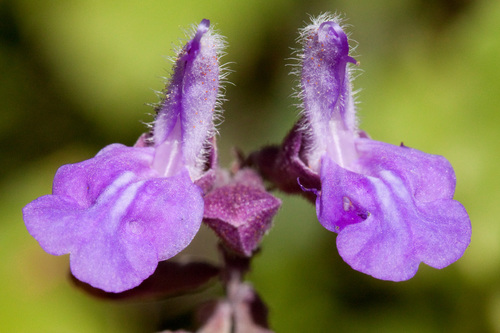
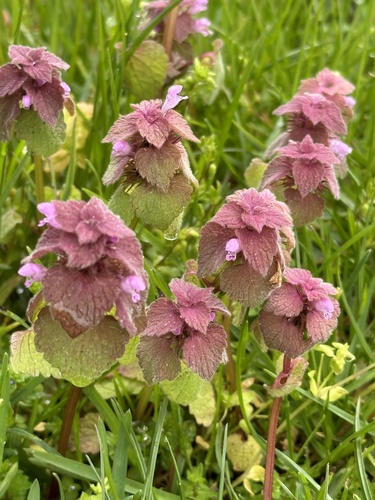
Lamium purpureum L. has square stems that grow 5–20 centimetres (2–8 in) tall, and rarely reach up to 40 cm (16 in). Its leaves are covered in fine hairs, green at the base and shifting to purplish tones at the top; they measure 2–4 centimetres (3⁄4–1+1⁄2 in) in both length and breadth, with a 1–2 cm (1⁄2–3⁄4 in) leaf stalk (petiole), and have margins ranging from wavy to serrated. Its zygomorphic flowers are bright red-purple, with five petals fused into a corolla tube. The corolla has a hood-like lobe at the top, two lower lip lobes, and small fang-like lobes between these structures. Inside the corolla are four stamens and a single style with a forked stigma. A line of hairs is visible near the base of the corolla tube. Flowers can be produced year-round, including during periods of mild winter weather. Lamium purpureum is native to Europe and Asia, but also grows in North America. It is common in western and eastern United States, Canada, Ireland, and Britain, and is frequently found growing in meadows, forest edges, roadsides, and gardens. Its year-round blooming habit means bees can collect nectar from it when very few other nectar sources are available. In the United Kingdom, it is also a prominent source of pollen for bees during March and April, when bees need this pollen as protein to build up their nests. The pollen of Lamium purpureum is crimson red, making it very noticeable on the heads of bees that visit its flowers. The edible tops and leaves of young plants can be used in salads or stir-fried as a spring vegetable. Finely chopped leaves can also be added to sauces. The flowers can be crystallized using sugar and egg white. This herb has a long history in English folk medicine, and appears as one of three medicinal and symbolic plants called for in the Anglo-Saxon herb charm Wið færstice, which translates to 'against a sudden/violent stabbing pain'. According to scholarly consensus, the charm dates to around the late ninth century. It instructs that the three herbs (the other two are feverfew and plantain) be heated in butter to make an ointment. This ointment is then rubbed onto the site of the pain with a knife blade, while the folk practitioner recites the full lengthy charm, aligning themselves with the patient against evil supernatural beings that were believed to cause the pain with magical arrows. Herbalists still use red dead-nettle for many herbal remedies today. One common remedy is a salve made from the plant, used topically to soothe irritated, itchy, or sore skin. Studies have found that Lamium purpureum has a strong antioxidant effect.