About Lamium hybridum Vill.
Lamium hybridum Vill., commonly called cut-leaf dead-nettle, is a low-growing annual plant that reaches 10–40 cm (3.9–15.7 in) in height.
Stem Features
Its stems are pubescent, covered in fine, soft hairs.
Leaf Characteristics
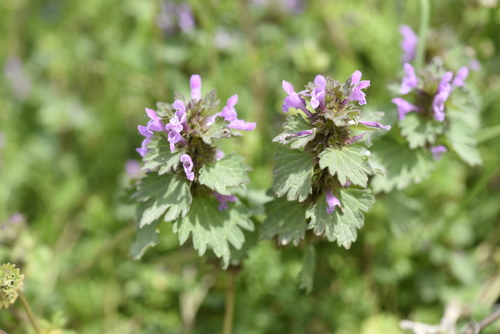
Leaves are arranged oppositely, ranging in shape from rounded to kidney-shaped, with a diameter of 2–3 cm (0.79–1.18 in), and have deeply lobed to incised margins.
Flower Appearance
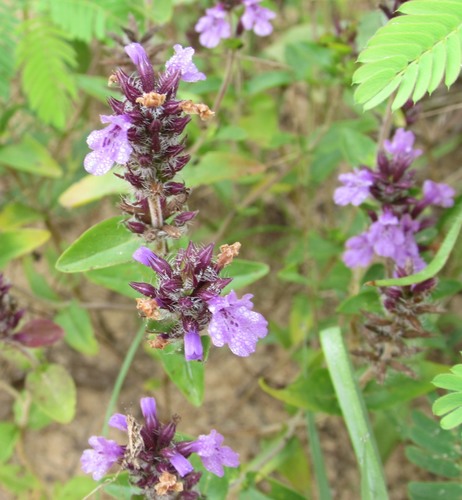
Flowers are similar in pink to purple color to those of Lamium purpureum, and are relatively small at 10–15 mm (0.39–0.59 in) long.
Flower Arrangement
They are arranged into a few-flowered terminal spike with additional axillary whorls.
Calyx Traits
The calyx is regular with five lobes, and closes up once flowering is complete.
Corolla Structure
The corolla is purplish-red, fused into a short tube; the upper lip is convex, while the lower lip has three lobes: two small side lobes and one larger elongated central lobe.
Corolla Hair Difference
Unlike L. purpureum, which has a distinct ring of hairs at the base of its corolla, the corolla base of Lamium hybridum Vill. is nearly hairless.
Stamen Details
There are four stamens, of which two are long and two are short.
Flowering Period
Flowering occurs from early spring through summer into mid autumn, typically from March to October in Britain.
Fruit and Reproduction
The gynoecium is formed from two fused carpels, and the fruit is a four-chambered schizocarp.
Ecological Role
This species propagates via seed, and acts as a source of nectar and pollen for bees.
Native Range
Cut-leaf dead-nettle is native to western and northern Europe, and northwest Africa's Atlas Mountains.
British Isles Status
Its native status in Great Britain and Ireland is disputed: some sources list it as native, while others classify it as an archaeophyte.
Habitat Preferences
It grows in open areas, gardens, fields, meadows, and is widespread in uncultivated areas of urban habitats.