About Lamium galeobdolon (L.) L.
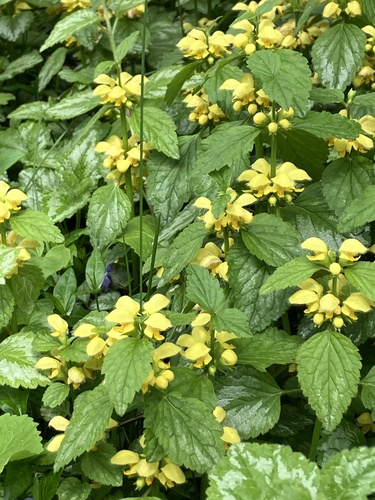
Lamium galeobdolon sensu lato is a perennial plant with square stems that grow 15 to 60 cm (6 to 24 in) tall. It bears paired opposite, stalked leaves with toothed margins, measuring 4 to 7 cm (2 to 3 in) long. Leaves may or may not have silvery markings, which is a key trait used to tell its subspecies apart. Its inflorescence is a verticillaster, a pseudo-whorl of 4 to 16 flowers clustered around the axil of a leaf pair. Each flower has bilateral (zygomorphic) symmetry, a five-lobed calyx, and a yellow corolla with a prominent hood. The flower's lower lip has three lobes, and the central lobe is often streaked with orange. It has two short and two long stamens. Flowering occurs from late spring to early summer, typically May to June in Britain. A pair of fused carpels produces a four-chambered schizocarp.
Within the genus Lamium, subspecies of Lamium galeobdolon sensu lato are the only taxa with yellow flowers. All subspecies are stoloniferous except subspecies flavidum. The invasive subspecies argentatum is easily identified by its silvery white variegated leaves. Subspecies galeobdolon and montanum are often hard to distinguish. When the plant is in full flower, subspecies galeobdolon has a maximum of six (rarely seven) flowers per verticillaster, while subspecies montanum averages ten flowers per verticillaster. Lower stem hairiness is another useful identifying clue: subspecies galeobdolon only has hairs on its four stem ridges, while subspecies montanum is uniformly hairy across both the stem faces and ridges. Lamium galeobdolon subsp. flavidum is distinct for having no stolons, frequently branched fertile stems with upright flowering lateral shoots, and 10 to 16 small flowers per verticillaster.
Other taxa in this group can have marked leaves, but subsp. argentatum has a unique leaf pattern: a permanent silvery pattern on the leaf blade always forms two bending bands along the midrib, and these bands are mostly not interrupted by lateral veins. This pattern is especially distinct from late autumn to early spring, when a contrasting brownish-maroon color develops on the leaf's underside and extends to the midrib zone of the upper leaf surface. While variegated leaves are often seen in all other studied taxa, their markings never match this pattern. Silvery-grey markings on other taxa are only separate splashes or flecks (small in L. montanum and L. flavidum, larger in L. galeobdolon) that do not merge into continuous bands. A combination of two distinct bending silvery bands and a strong chocolate-maroon zone along the midrib in winter can be considered a unique identifying marker for L. argentatum. One cultivar of subspecies flavidum, 'Herman's Pride', has silver-spotted leaves; though its markings are not like those of subspecies argentatum, the two are sometimes confused.
The base chromosome number for all taxa in the genus Lamium is x = 9. Lamium galeobdolon subsp. flavidum and subsp. galeobdolon are diploid (2n = 2x = 18), while subsp. argentatum and subsp. montanum are tetraploid (2n = 4x = 36). A small number of triploid individuals have been reported, and these triploids are thought to be natural hybrids between diploid subsp. galeobdolon and tetraploid subsp. argentatum.
Lamium galeobdolon sensu lato is native to Europe, western Asia, and parts of the Middle East. Its range extends from Ireland and Spain east across Europe to the West Siberian Plain, and southeast to Iran. Subspecies flavidum is native to the Alps, northern Italy, and the mountain ranges northeast of the Adriatic Sea. Subspecies galeobdolon and montanum have broadly similar distributions, but montanum extends further west and south than galeobdolon, which has a more northeasterly distribution. Within Britain and Ireland, subspecies montanum is widespread across England and Wales, and found locally in southern Scotland and eastern Ireland, while subspecies galeobdolon is restricted to a small area in Lincolnshire in eastern England.
Lamium galeobdolon sensu lato has been widely introduced to many European countries outside its native range, as well as New Zealand, Canada, and the United States, but authorities do not agree on the distribution of introduced subspecies. As of April 2024, Plants of the World Online (POWO) states that subspecies argentatum has been introduced to Great Britain, Ireland, and Italy, but this list is incomplete because the subspecies is also reported as introduced in the Netherlands and Switzerland. POWO also claims that subspecies galeobdolon has been introduced to Madeira, both the North and South Islands of New Zealand, and the United States, but iNaturalist data shows that subspecies argentatum is the most widespread subspecies in all of these areas. Since North American authoritative sources implicitly refer to Lamium galeobdolon sensu lato, POWO's claim is unsubstantiated. The number of U.S. states where Lamium galeobdolon sensu lato is reported to occur varies greatly depending on the source.
Lamium galeobdolon sensu lato has been widely introduced as a garden plant, often sold under the name Lamiastrum galeobdolon. Especially in New Zealand, Canada, and the United States, it has escaped cultivation and become an invasive species. In New Zealand, it is listed in the 2020 National Pest Plant Accord, so it is banned from sale, propagation, and distribution across the country. It is also listed by the Invasive Species Council of British Columbia in Canada. In the U.S. state of Washington, it is classed as a Class B Noxious Weed and banned from sale under state law. It is also a B-listed Noxious Weed in the state of Oregon.
The variegated yellow archangel (Lamium galeobdolon subsp. argentatum) has become an invasive subspecies in several European countries. In the Netherlands, it was introduced as an ornamental ground cover, and by 1985 it had naturalized and been recorded in more localities than the native subspecies galeobdolon. It is also invasive in Britain, where it spreads via stolons at a rate of 1 to 2 meters per growing season. In western England, it is found far from human settlements, which suggests it did not originate from discarded garden waste and spreads by other means. In Switzerland, subspecies argentatum tripled its occurrence between 1980 and 2020, and has a higher growth rate and regeneration capacity than the native subspecies galeobdolon.
Outside of its native range, which invasive subspecies of Lamium galeobdolon occurs in particular areas is largely unknown. In the Lower Mainland of British Columbia, the invasive form is said to be a cultivar of subspecies montanum called 'variegatum', also known as 'Florentinum'. A cultivar of subspecies argentatum also called 'Florentinum' (and 'variegatum') has invaded the Seattle area in Washington State.
Early botanists hypothesized that the tetraploid subsp. montanum originated as a hybrid between the two diploid taxa subsp. flavidum and subsp. galeobdolon, based on morphological traits, chromosome number, geographic distribution pattern, and phytochemistry. However, more recent phylogenetic data suggests that subsp. montanum originated from subsp. flavidum alone. There is also conflicting evidence about the origin of the tetraploid subsp. argentatum, so it remains unclear whether it originated from subsp. galeobdolon alone.