About Lamium amplexicaule L.
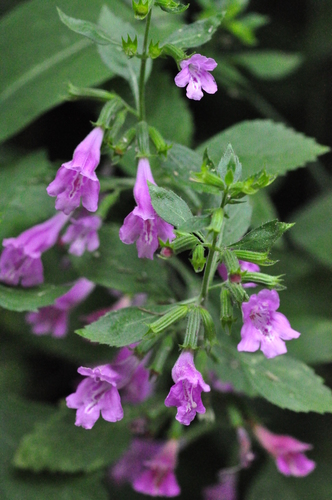
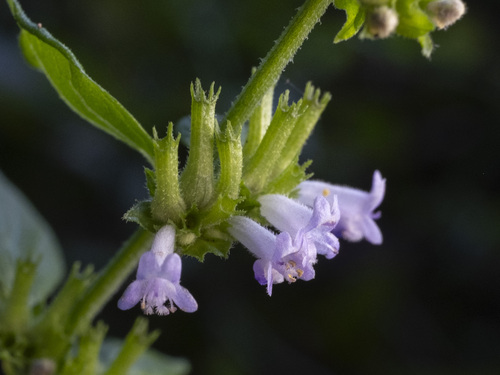
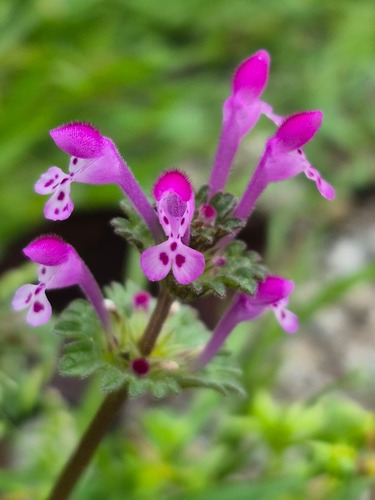
Lamium amplexicaule L., commonly known as henbit dead-nettle, is a low-growing annual plant. It reaches 10–25 cm (4–10 in) tall, rarely growing up to 40 cm, and has thinly pubescent, soft, finely hairy stems. Its leaves are arranged oppositely, are rounded to kidney-shaped, 2–3 cm (3⁄4–1+1⁄4 in) in diameter, and have lobed margins; plants often have long leaf internodes. Lower leaves are stalked, while upper leaves are stalkless, often fused, and clasp the stems. Its flowers are pink to purple, relatively large, and 1.5–2 cm (1⁄2–3⁄4 in) long, growing in a few-flowered terminal spike with axillary whorls. The calyx is regular with five lobes and closes up after flowering. The corolla is purplish-red, fused into a usually erect tube 15 to 20 mm (1⁄2 to 3⁄4 in) long. The upper lip of the corolla is convex and 3 to 5 mm (1⁄8 to 3⁄16 in) long, while the lower lip has three lobes: two small side lobes and a larger central lobe 1.5 to 2.5 mm (1⁄16 to 1⁄8 in) long. There are four stamens, two long and two short. The gynoecium has two fused carpels, and the fruit is a four-chambered schizocarp. This plant flowers very early in spring even in northern areas, and flowers for most of the winter and early spring in warmer locations such as the Mediterranean region. When few pollinating insects are active at certain times of year, its flowers self-pollinate. It often grows alongside Lamium purpureum (red dead-nettle), and is easily mistaken for that species because both have similar leaves and similar bright pink to purple flowers. They can be distinguished by the form of leaves on their respective flowering stems: the leaves of red dead-nettle are petiolate (stalked), while the leaves of henbit dead-nettle are sessile (stalkless). Henbit dead-nettle is native to most of Europe, Asia and North Africa, and has since been spread around the world by human activity. It is widely naturalised in eastern North and South America, New Zealand, South Africa and Tasmania. Its native status in Great Britain and Ireland is disputed; some sources list it as native, while others classify it as an archaeophyte. It grows in open areas, gardens, fields and meadows, and is widespread in uncultivated areas within urban habitats. It propagates freely by seed, and becomes a key part of meadow ecosystems; sometimes entire fields turn reddish-purple with its flowers before spring ploughing. Due to its attractive appearance, edibility, and ability to grow readily in many climates, it is often allowed to grow in places where other weeds are removed. Its seeds are eaten by many species of birds. Where it is common, it is an important nectar and pollen source for bees, especially honeybees. It also provides forage for animals. It is often considered a weed, and is even classified as invasive in some U.S. states. The young leaves and shoots of henbit dead-nettle can be eaten raw or cooked; stems and flowers are also edible. It has a slightly sweet and peppery flavour, similar to celery.