About Lamium album L.
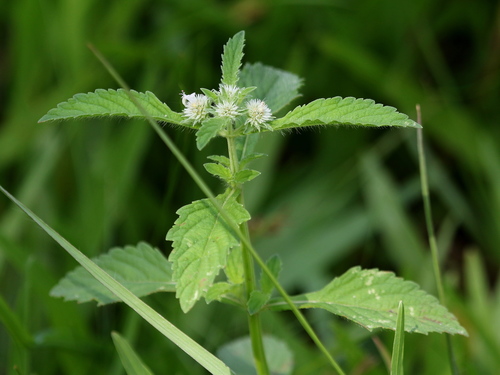
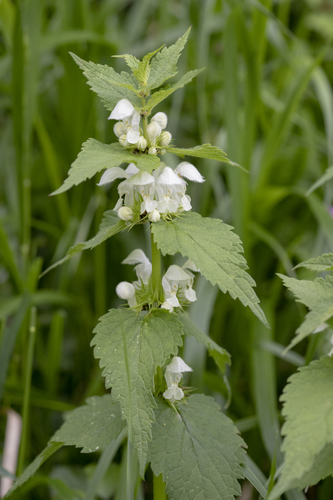
Lamium album L. is a rhizomatous herbaceous perennial that grows up to 70 cm (28 in) tall, with green, four-angled stems. Its leaves are 3–8 cm (1–3 in) long and 2–5 cm (3⁄4–2 in) wide; they are triangular with a rounded base, softly hairy, have serrated margins, and grow on petioles that can reach 5 cm (2 in) long. Like many other species in the Lamiaceae family, Lamium album leaves look similar on the surface to leaves of the stinging nettle Urtica dioica, but do not sting, which is how the plant got its common name "dead-nettle". The flowers are white, borne in whorls called verticillasters on the upper portion of the stem. Individual flowers measure 1.5–2.5 cm (5⁄8–1 in) long. This species is native to Eurasia, ranging from Ireland in the west to Japan in the east. It is divided into three subspecies: subsp. album occurs across the western part of the species' range, subsp. crinitum grows in the southern range portion in southwest Asia, from Turkey to Nepal, and subsp. barbatum is found in the far east of mainland Asia and in Japan. Lamium album is common in England, rare in western and northern Scotland, and was introduced to eastern Ireland. It is abundant in the British Isles, where it grows along roadsides, around hedges, and in abandoned areas. This species was introduced to North America, where it is now widely naturalized. A wide variety of insects visit Lamium album flowers, but the plant is most often visited by long-tongued insects such as bees. Bumblebees are particularly attracted to its flowers, which provide a good source of early nectar and pollen, giving the plant the alternate common name "bee nettle". The young shoots and leaves of Lamium album can be cooked and eaten as a vegetable.