About Lagopus muta (Montin, 1781)
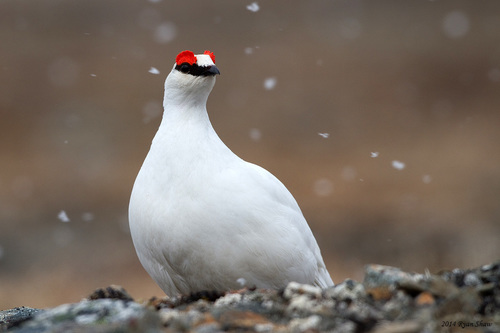
Lagopus muta, commonly called the rock ptarmigan, measures 34–36 cm (13–14 in) in length, has an 8 cm (3.1 in) tail, a 54–60 cm (21–24 in) wingspan, and weighs 440–640 g (15.5–22.6 oz). It is roughly 10 percent smaller than the willow ptarmigan. The rock ptarmigan has seasonal camouflage, with feathers moulting from white in winter to grey and brown in spring and summer. Breeding males have greyish upper bodies, paired with white wings and underparts. In winter, its plumage turns entirely white except for black outer tail feathers and a black eye line. Rock ptarmigan can be told apart from winter willow ptarmigan by habitat: the rock ptarmigan prefers higher elevations and more barren terrain. It also has a more slender bill than the willow ptarmigan, and male rock ptarmigan have black lores that are absent in willow ptarmigan; these black lores are also absent in female rock ptarmigan. The rock ptarmigan is a sedentary species that breeds across Arctic and Subarctic Eurasia and North America, including Greenland, on rocky mountainsides and tundra. It is widespread in the Arctic Cordillera and across the Eurasian Arctic, ranging from Norway and Sweden east to the Siberian Far East. It also occurs in isolated populations in the mountains of Scotland, the Pyrenees, the Alps, Bulgaria, the Urals, the Pamir Mountains, the Altay Mountains, and Japan, where it is found only in the Japanese Alps and on Mount Haku. Due to its remote habitat, it has only a few predators, most notably gyrfalcons, golden eagles, and arctic foxes, and it can be surprisingly approachable by people. The small population living on Franz Josef Land in the Russian High Arctic overwinters during the polar night, surviving by feeding on the rich vegetation on and underneath high cliffs that host seabird colonies in summer. In Great Britain, the species was present in England's Lake District fells until the early 1800s, and persisted slightly later in the Southern Uplands of Scotland, but is now absent from both regions, occurring only in the Scottish Highlands. During the last ice age, the species was much more widespread across continental Europe than it is today.