About Lagopus leucura (Richardson, 1831)
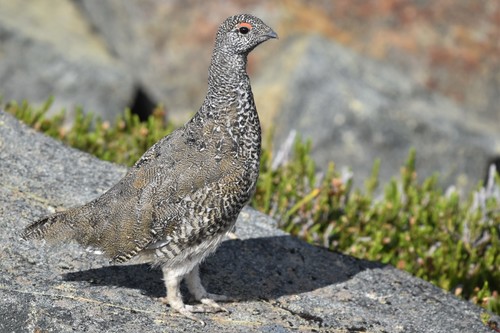
Description: The white-tailed ptarmigan, scientific name Lagopus leucura (Richardson, 1831), is the smallest of all ptarmigans, and also the smallest bird in the grouse tribe. It is a stocky bird, with rounded wings, a square-ended tail, a small black beak, and short legs that have feathers extending all the way to the toes. Adult white-tailed ptarmigan measure 11.8 to 12.2 inches (30 to 31 cm) in total length, with males only slightly larger than females. Their average weight ranges from 11.6 to 16.9 ounces (330 to 480 g). During summer, white-tailed ptarmigan have speckled grayish brown plumage, with white underparts, tail, and wings. In fall, their plumage shifts to a much darker reddish-brown, and new white feathers begin growing in. By winter, all the brown summer feathers have been shed, and the bird becomes completely white. An additional molt in spring happens before the breeding season, and the bird regains its summer plumage. The finely barred greyish coloration on its back makes this species easy to distinguish from the much browner willow ptarmigan and rock ptarmigan. Both sexes keep white tail and wing feathers year-round, and males can be identified by their reddish eyecombs (fleshy growths above the eye), which are also present year-round. Overall, this bird is silent, but it will sometimes produce quiet, low-pitched hoots and soft clucking sounds. Distribution: The white-tailed ptarmigan is an alpine species, and a permanent resident of high mountains located at or near the timber line. It lives in open country and flies much more often than forest grouse, but still prefers running over flying. Its natural range extends from Alaska and western Canada south to northern New Mexico. Males return from their wintering areas to establish territories on spruce-willow timber line breeding grounds in April. Females arrive in early May, and pairs then form. The white-tailed ptarmigan is the only bird in North America that resides permanently in the alpine zone. Its typical habitat includes areas with boulders, krummholz, snowfields, rock slides, frost-heaved soil, and upland herbage. Even in winter, it remains in high valleys and mountain slopes where alder, willow, birch, and spruce grow through the snow cover. This species was introduced to the Sierra Nevada of California and the Uinta Mountains of Utah in the 1970s. It may have been native to these areas during the early Pleistocene, but became locally extinct due to climate change, as increased spring snow cover negatively impacted its breeding season. Alternatively, it may never have been able to colonize the Sierra Nevada naturally, because of geographic barriers formed by the Columbia River, the Great Basin, and the low altitudes of the intervening South Cascades. The first introduction of white-tailed ptarmigan to Oregon's Wallowa Mountains happened in September 1967, when 36 birds captured from Colorado and Washington were released there. A second group of 54 birds, sourced from Colorado and British Columbia, was released in September 1968. Although a few of these birds were observed in spring and summer of 1969, the attempt to establish a permanent population in Oregon was ultimately unsuccessful.