About Lagopus lagopus (Linnaeus, 1758)
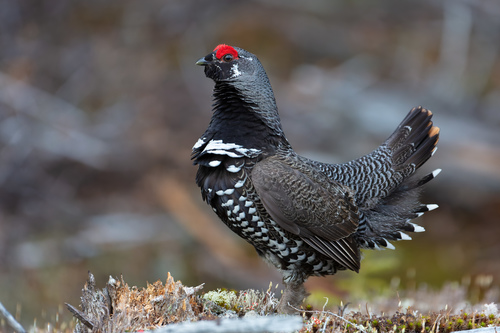
The willow ptarmigan (Lagopus lagopus) is a medium to large ground-dwelling bird, and the most numerous of the three recognized ptarmigan species. Adult males and females are approximately the same size: adult length ranges between 35 and 44 centimetres (14 and 17 in), wingspan ranges from 60 to 65 centimetres (24 and 26 in), and weight falls between 430 and 810 grams (15 to 29 oz). It has a deep chest, a fairly long neck, a broad bill, short feathered legs, and a moderately short rounded tail. In summer, males have marbled brown plumage with a reddish tint to the neck and breast, a black tail, and white wings and underparts. They have a red semicircular comb above each eye, which turns bright red and becomes prominent during the breeding season. Females are similar in overall appearance, but have much smaller eye combs, and have brown feathers scattered among the white feathers on their belly. In winter, the body plumage and two central tail feathers of both sexes turn completely white, with the exception of the black outer rectrices. Wing feathers stay white year-round. Juvenile birds resemble adult willow ptarmigan. The willow ptarmigan can be told apart from the closely related rock ptarmigan (Lagopus muta) by its larger size, thicker bill, and its typical habitat below the tree line, while rock ptarmigan prefer more elevated, barren habitats. The willow ptarmigan's summer plumage is browner than the rock ptarmigan's, and in winter male willow ptarmigan do not have the black stripe between the eye and bill that male rock ptarmigan have. The white-tailed ptarmigan (Lagopus leucura) of North America is smaller than the willow ptarmigan, has a white tail and finely-barred greyer plumage, and lives permanently above the tree line. The distinctive red grouse of the British Isles was once classified as a subspecies of the willow ptarmigan; this moorland bird is reddish brown all over its body, except for its white feet. The willow ptarmigan's voice is low-pitched and guttural, and includes chuckles, repeated clucking sounds, and expostulations. When displaying, males produce rattles and barking noises. The willow ptarmigan has a circum-boreal distribution. It is native to Canada, the United States, China, Mongolia, the Russian Federation, Kazakhstan, the Czech Republic, Finland, Norway, Sweden, Estonia, Latvia, and Lithuania. It primarily lives in subalpine and subarctic habitats, including sparse pine and birch forests, thickets with willow and alder trees, heather moors, tundra, and mountain slopes. In winter, females and sub-adults may move to lower altitudes and seek shelter in valleys or more densely vegetated areas, but adult males usually stay in the subalpine region. Red grouse are common on heather-covered moorland across northern and western Great Britain, and in localized areas of Ireland.