About Laetiporus sulphureus (Bull.) Murrill
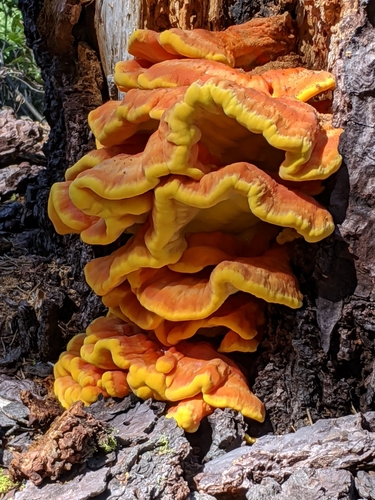
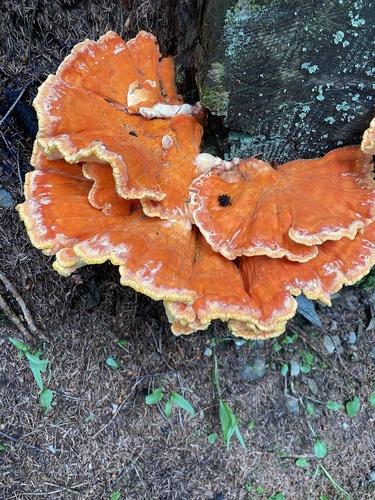
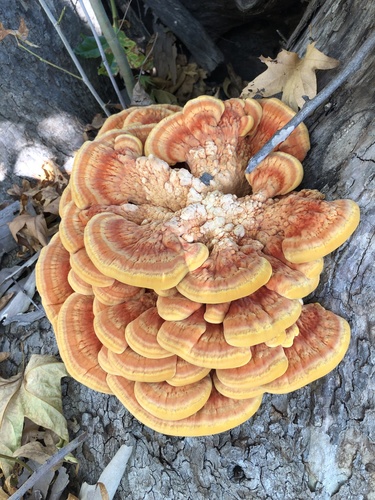
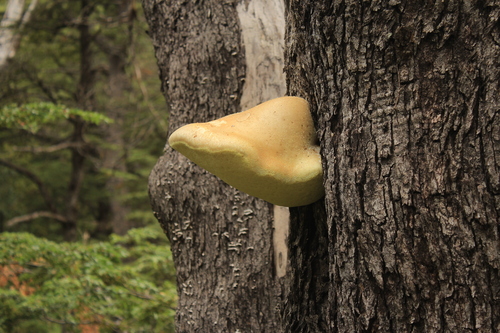
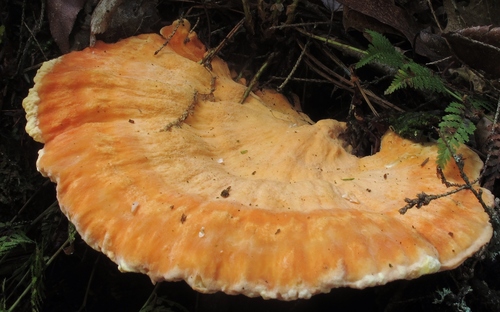
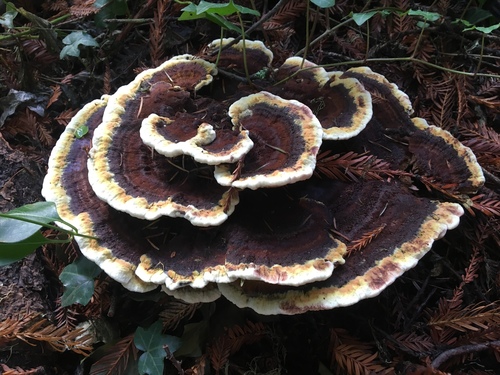
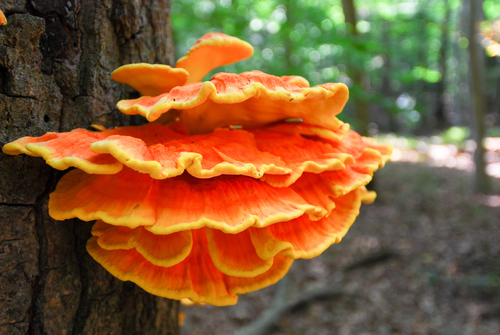
The fruiting body of Laetiporus sulphureus (Bull.) Murrill emerges directly from tree trunks. It starts as a knob shape, then quickly expands into fan-shaped shelves that typically grow in overlapping tiers. Its color ranges from sulphur-yellow to bright orange, and it has a suede-like texture; old fruitbodies fade to tan or whitish. Each individual shelf measures between 5 to 60 centimetres (2 to 23 and 1⁄2 inches) across, and is up to 4–12 cm (1+1⁄2–4+1⁄2 inches) thick. The fertile surface is sulphur-yellow, with small pores or tubes, and produces a white spore print. When fresh, the flesh is succulent, carries a strong fungal aroma, and exudes yellowish, transparent juice, but it quickly becomes dry and brittle. While this species is fairly distinct in appearance, it can resemble Laetiporus persicinus. Laetiporus sulphureus is widely distributed across Europe (where it can be found from April to November) and North America, though its North American range may be restricted to areas east of the Rocky Mountains. It grows on dead or mature hardwood trees, and has been reported from a very wide variety of host trees including Quercus, Prunus, Pyrus, Populus, Salix, Robinia, and Fagus. It is occasionally also found growing on conifers. Its growing season runs from August to October or later, and sometimes starts as early as June. In the Mediterranean region, this species is usually found growing on Ceratonia and Eucalyptus. It most often grows in clusters. Certain species of deer eat this mushroom. Some people experience gastrointestinal upset after eating this mushroom, and it should not be consumed raw. Severe adverse reactions including vomiting and fever occur in about 10% of the population, though these reactions are now thought to stem from confusion with morphologically similar species: Laetiporus huroniensis, which grows on hemlock trees, and L. gilbertsonii, which grows on Eucalyptus. Compared to widely cultivated species like Agaricus bisporus (the Swiss Brown mushroom) and oyster mushrooms, commercial cultivation of Laetiporus sulphureus happens at a much smaller, less mechanized scale. Due to its flavor profile, Laetiporus sulphureus is commonly called the chicken polypore and chicken-of-the-woods — this common name should not be confused with Grifola frondosa, which is known as hen-of-the-woods. Many people report this mushroom tastes like crab or lobster, giving it the additional nickname lobster-of-the-woods. The authors of Mushrooms in Color noted that the mushroom tastes good when sauteed in butter or prepared in a cream sauce served on toast or rice. It is held in high regard as food in Germany and North America. Young specimens are edible when they exude large amounts of clear to pale yellow watery liquid. For larger specimens, only the young outer edges should be collected, because older portions are tough, unpalatable, and often become bug-infested. This mushroom should never be eaten raw.