About Laetiporus portentosus (Berk.) Rajchenb.
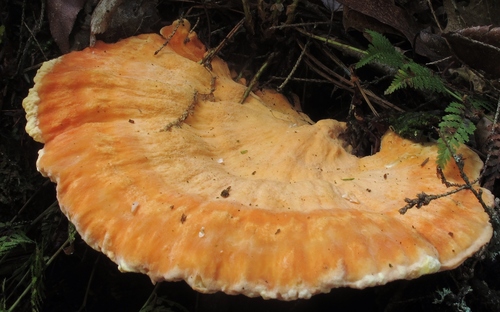
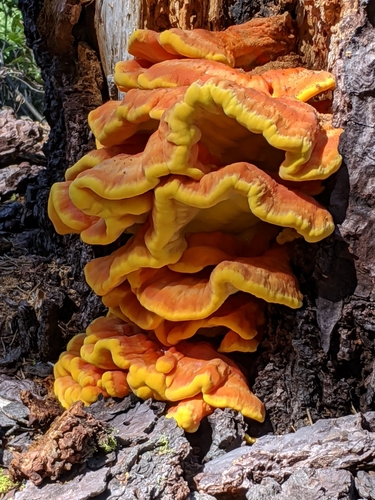
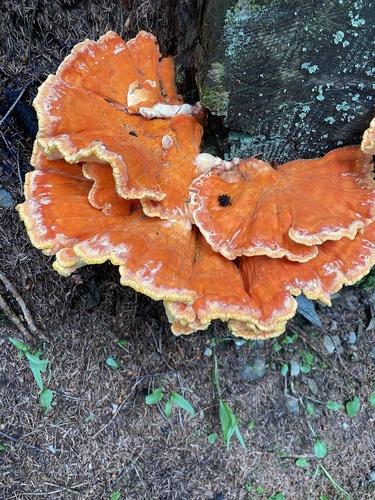
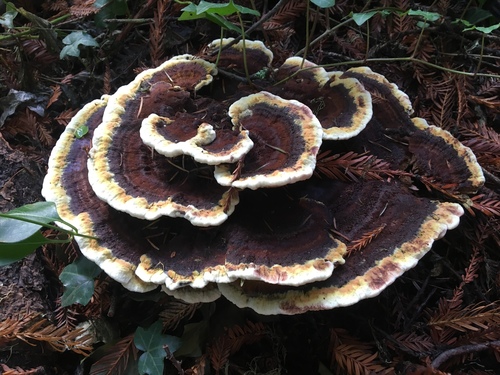
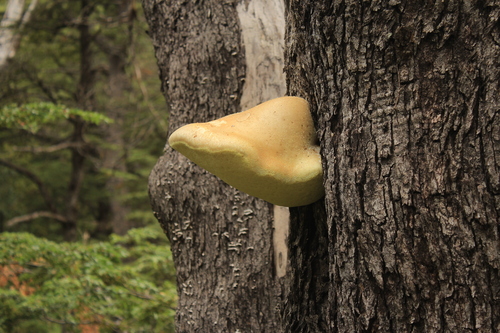
Laetiporus portentosus is a fungus that forms yellowish or white, flattened, bulbous masses. When dry, it has a consistency similar to expanded polystyrene, and when fully wet, it is soft like a sponge. Its upper surface is light brown, while its underside is paler and marked with small but visible pores that number 1–3 pores per millimetre. The fruiting body is often completely eaten by grubs, resulting in a spongy texture. This fungus typically grows several meters above ground, reaching 10–30 cm across and up to 6 cm thick. In Māori tradition of New Zealand, this species is strongly associated with the small tree hutu (Ascarina lucida), so much that it is known by the Māori name ngā huruhuru o hutu waewae, meaning "the hairs on the legs of hutu". It is also found growing on southern beech (Nothofagus) trees in New Zealand. White-throated treecreepers (Cormobates leucophaea) have been recorded feeding on this fungus in a heathy dry forest in Victoria, Australia. One study comparing wood-inhabiting fungi found that L. portentosus has a high ability to decompose the heartwood of Nothofagus pumilio, and a low ability to decompose the species' sapwood. Traditionally, both Australian Aboriginal people and New Zealand Māori people have used L. portentosus as tinder and for carrying fire. When dried and lit, the fungus smoulders very slowly, making it a reliable ignition source. Smouldering pieces of the fungus could be half-buried in the ground where they would burn for one to two days, carried between locations in ornately carved tinderboxes, or placed on top of a stick to light the way during night travel. Pākehā also used pūtawa (the common name for this fungus) as a fire starter substitute for touchpaper, carrying it in cigarette tins. Pieces of this fungus were even sent with flint stones to New Zealand troops in both World Wars to help them light cigarettes and pipes. Māori cut pūtawa into absorbent strips to wrap as bandages around wounds, protecting wounds from pressure. It was also possibly taken internally "to soften and ease a difficult labour."