About Laeosopis roboris (Esper, 1790)
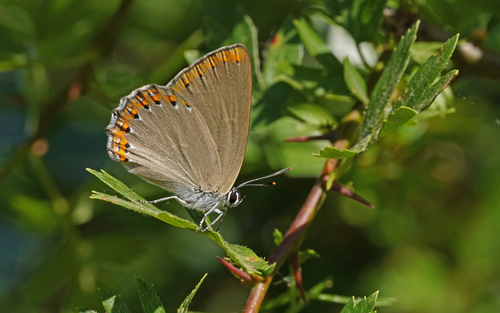
This species is scientifically known as Laeosopis roboris (Esper, 1790). The description in Seitz describes the nominal form as L. roboris Esp. (= evippus Hbn.) (72 d). Its upperside is black: males have ultramarine scaling extending from the wing base out to the broad outer area, while females only have this ultramarine scaling in the basal area. The underside is ashy grey, with a yellow margin that holds light blue spots; proximally before this margin are black dots edged with pale color. The nominal form is only found in South France (especially the Pyrenees) and Spain. The subspecies or form lusitanica Stgr. (72 d) is found in Portugal; it has a more glossy yellow underside and a broad yellowish red marginal band, which bears almost no spots on the forewing. While nymotypical roboris occurs in South Spain, Staudinger collected a transitional form in Castilia. The egg of this species is globular and reddish. The larva is woodlouse-shaped and grey, covered in short black bristles, with two dark yellow, interrupted dorsal lines; there is a black spot behind the head between these lines. The larva's venter is dirty yellow, and its legs are yellow. Larvae are sluggish in movement, but feed quickly according to Hofner. They develop from April until the end of May, feeding on ash and privet. The pupa is barrel-shaped, and secured with several separate threads. Adult butterflies occur from June until autumn in tree- and shrub-covered valleys, and are abundant in some locations. They settle particularly often on ash and chestnut trees; when disturbed, they generally return to the same spot, so they are easily collected in good condition, as noted by Elwes. Adult butterflies fly from April to October, with timing varying by location.