About Lactuca serriola L.
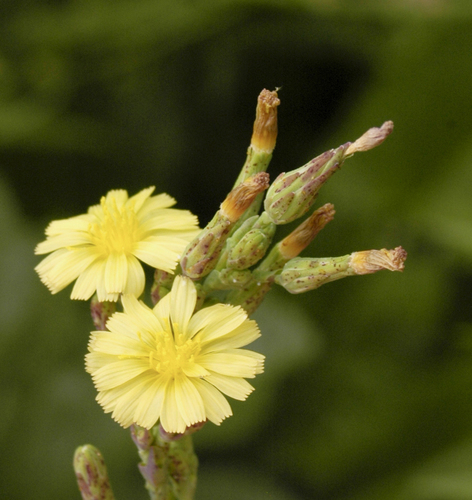
Lactuca serriola L. has a spineless, reddish stem that contains milky latex and grows up to 2 metres (6 ft 7 in) tall. Its leaves get progressively smaller toward the top of the stem. They are oblong or lanceolate, often pinnately lobed, and especially lower leaves are waxy grey-green. Fine spines grow along the leaf veins and edges, and leaf undersides have whitish veins. Leaves emit latex when cut. The flower heads are 1–1.5 cm (1⁄2–1⁄2 in) wide, pale yellow, often tinged purple, with 12–20 ray flowers and no disc flowers. The bracts are also often tinged purple. In the northern hemisphere, this species flowers from July to September. Its achenes are grey and tipped with bristles, and its pappus is white with hairs of equal length. Lactuca serriola is called the compass plant because upper leaves twist in sunlight to hold their margins upright, pointing roughly south or north from the stem. It is similar to Mycelis muralis, but has more than 5 florets. Lactuca serriola is native to Europe, Asia, and north Africa, and has become naturalized in other regions. If cattle feed exclusively on this plant, it can cause pulmonary emphysema. Lactuca serriola can be eaten in salads, though it has a somewhat bitter taste. Young leaves can be eaten raw or cooked, while older leaves can be steamed. Its roots are not substantial, but have been used as a coffee substitute. This plant’s presence in some ancient deposits has been linked to its soporific properties, which may indicate past ritual use. The Ancient Greeks believed its pungent juice was a remedy for eye ulcers, and Pythagoreans called this lettuce eunuch because it causes urination and reduces sexual desire. After its accidental introduction to North America, the Navajo began using the plant as a ceremonial emetic. On the Greek island of Crete, the leaves and tender shoots of a local variety called maroula (μαρούλα) or agriomaroulo (αγριομάρουλο) are eaten boiled. A growing number of Jews and Samaritans use this plant as the Maror (bitter herb) for Passover (called Pesach in Hebrew). Lactuca serriola contains lactucarium, the milky white latex that flows through its stem. When the plant is air-dried, it is used as a medicinal herb. While the standard definition of lactucarium requires production from Lactuca virosa, it has been recognized that smaller quantities of lactucarium can be produced in the same way from Lactuca sativa and Lactuca canadensis var. elongata, and that lettuce-opium obtained from Lactuca serriola or Lactuca quercina was of superior quality.