About Lactuca sativa L.
Lactuca sativa L., commonly known as lettuce, is native to an area stretching from the Mediterranean to Siberia, though it has been introduced to nearly every region of the world. Mature plants typically grow 15 to 30 cm (6 to 12 in) tall and wide. Lettuce leaves display a range of colors, mostly falling in the green and red spectrums, with some variegated cultivars, and a small number of varieties that have yellow, gold, or blue-teal leaves. Leaf shapes and textures vary widely, from the dense compact heads of iceberg-type lettuce to the notched, scalloped, frilly, or ruffly leaves of loose-leaf varieties.
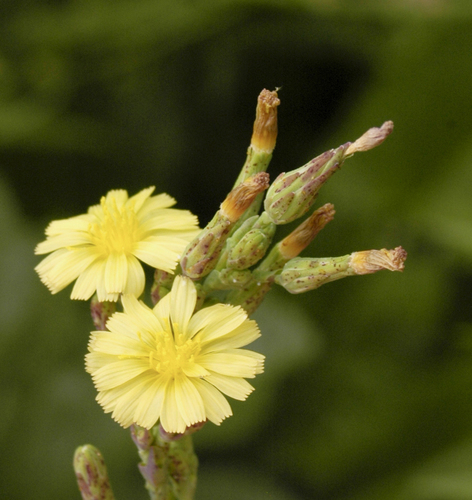
Lettuce has a root system made up of a central main taproot and smaller secondary roots. Varieties grown in the United States and Western Europe usually have long, narrow taproots and a small set of secondary roots, while varieties from Asia have longer taproots paired with more extensive secondary root systems. From planting to harvest, the lettuce growing cycle typically lasts 65 to 130 days, depending on variety and season. When lettuce bolts (begins to produce flowers), its leaves turn bitter and become unmarketable, so lettuce grown for food is almost never allowed to reach full maturity. Hot temperatures speed up bolting, while freezing temperatures slow growth and can damage outer leaves. After passing the edible stage, lettuce grows flower stalks that can reach up to 1 m (3 ft 3 in) tall, bearing small yellow blossoms.
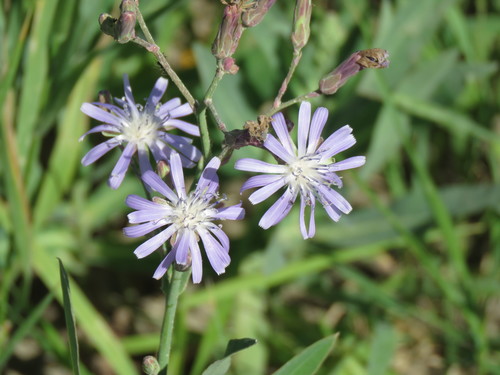
Like other members of the tribe Cichorieae, lettuce inflorescences (also called flower heads or capitula) are made up of multiple individual florets. Each floret has a modified calyx called a pappus, which becomes the feathery, parachute-like structure attached to the mature fruit, five petals fused into a single strap-shaped ligule, and internal reproductive structures. These reproductive parts include fused anthers that form a tube surrounding a style and a two-part stigma. When anthers release pollen, the style elongates to push the pollen-coated stigmas out of the anther tube. Ovaries develop into compressed, teardrop-shaped (obovate) dry, closed fruits that are 3 to 4 mm long at maturity. Each fruit has 5 to 7 ribs on each side, and is tipped with two rows of small white hairs, with the pappus remaining at the top to aid in seed dispersal. Each fruit holds a single seed, which can be white, yellow, gray, or brown depending on the lettuce variety.
Centuries of domestication and selective breeding have altered lettuce to produce several favorable traits: delayed bolting, larger seeds, larger leaves and heads, improved taste and texture, lower latex content, and a wider range of leaf shapes and colors. Selective breeding work on these traits continues today. Research into genetically modified lettuce is also ongoing, with over 85 field trials conducted between 1992 and 2005 in the European Union and United States testing modifications for increased herbicide tolerance, greater resistance to insects and fungi, and slower bolting. However, genetically modified lettuce is not currently used in commercial agriculture.
Lettuce is a hardy annual. Some varieties can be overwintered even in relatively cold climates when covered with a layer of straw, and older heirloom varieties are often grown in cold frames. Leaf lettuces grown for harvesting individual leaves are usually sown directly into garden beds in thick rows. Heading varieties are most commonly started in growing flats, then transplanted to individual spaced spots in the garden once they develop several leaves, usually planted 20 to 36 cm (7.9 to 14.2 in) apart. More widely spaced lettuce receives more sunlight, which improves leaf color and nutrient content; pale to white lettuce, such as the inner heart of some iceberg lettuce, contains very few nutrients.
Lettuce grows best in full sun, in loose, nitrogen-rich soils with a pH between 6.0 and 6.8. Heat generally triggers bolting, and most varieties grow poorly at temperatures above 24 °C (75 °F). It performs best in cool conditions, with an ideal growing temperature of 16 to 18 °C (61 to 64 °F), and can tolerate temperatures as low as 7 °C (45 °F). In hot regions, providing lettuce with partial shade during the hottest part of the day slows bolting. Lettuce seed germination is generally poor or fails entirely at temperatures above 27 °C (81 °F). After harvest, lettuce stays fresh longest when stored at 0 °C (32 °F) and 96 percent humidity. Lettuce has a very high water content of 94.9 percent, which makes conventional preservation methods impossible—it cannot be successfully frozen, canned, or dried, and must be eaten fresh. Despite this high water content, traditionally grown lettuce has a low water footprint: 237 liters (52 imp gal; 63 U.S. gal) of water is required to produce one kilogram of lettuce. Hydroponic growing can cut this water consumption by almost two orders of magnitude.
Different lettuce varieties can cross-pollinate with each other, so when saving seeds, varieties must be planted 1.5 to 6 m (60 to 240 in) apart to prevent unwanted cross-contamination. Lettuce also cross-pollinates with Lactuca serriola (wild lettuce), and seeds from these crosses typically produce plants with tough, bitter leaves. Celtuce, a lettuce variety grown primarily in Asia for its edible stems, crosses easily with leaf-type lettuces. This tendency to outcross has been useful for breeding programs, which use closely related Lactuca species such as L. serriola, L. saligna, and L. virosa to broaden the available lettuce gene pool. Starting in the 1990s, these programs began to also include more distantly related species like L. tatarica.
Lettuce seeds store best in cool conditions. Unless stored cryogenically, they remain viable longest when stored at −20 °C (−4 °F), and are relatively short-lived in storage. At room temperature, lettuce seeds only remain viable for a few months. If newly harvested lettuce seed is stored cryogenically, however, its storage life increases dramatically: it has a half-life of 500 years when stored in vaporized nitrogen, and 3,400 years when stored in liquid nitrogen. This extended longevity is lost if seeds are not frozen promptly after harvesting.
Soil nutrient deficiencies can cause a range of issues for lettuce, from malformed plants to failure to form a head. Many insect pests feed on or damage lettuce: cutworms cut young seedlings off at the soil line; wireworms and nematodes cause yellowing and stunted growth; tarnished plant bugs and aphids cause yellow, distorted leaves; leafhoppers cause stunted growth and pale leaves; thrips turn leaves gray-green or silver; leafminers create tunnels inside leaves; flea beetles cut small holes in leaves; and caterpillars, slugs, and snails cut large holes in leaves. For example, ghost moth larvae are a common lettuce pest. Mammals including rabbits and groundhogs also eat lettuce plants. Lettuce produces several natural defensive compounds, including sesquiterpene lactones and other natural phenolics such as flavonol and glycosides, that help protect it against pests. Some varieties contain higher amounts of these compounds than others, and selective breeding and genetic modification research have focused on using this trait to develop commercial varieties with increased pest resistance.
Lettuce is also affected by several viral diseases: big vein, which causes yellow, distorted leaves, and mosaic virus, which is spread by aphids and causes stunted growth and deformed leaves. Aster yellows is a bacterial disease carried by leafhoppers that also causes deformed leaves. Fungal diseases include powdery mildew and downy mildew, which cause leaves to develop mold and die, as well as bottom rot, lettuce drop, and gray mold, which cause entire plants to rot and collapse. One bacterial disease is Botrytis cinerea, which can be treated with UV-C; a 2017 study by Vàsquez et al. found that UV-C treatment increases phenylalanine ammonia-lyase activity, phenolic production, and resistance to B. cinerea. Overcrowding of lettuce tends to attract more pests and diseases. Weeds are also a problem, because cultivated lettuce generally does not compete well with weeds, especially when it is directly sown in the garden. Transplanted lettuce (started in flats and moved to growing beds later) is initially more competitive, but can still be crowded by weeds later in the season, leading to misshapen heads and lower yields. Weeds also shelter insects and disease pathogens, and make harvesting more difficult. Herbicides are commonly used for weed control in commercial lettuce production, and this practice has led to the development of herbicide-resistant weeds in lettuce cultivation.
A number of food-borne pathogens can survive on lettuce, including Listeria monocytogenes, the bacterium that causes listeriosis, which can multiply in stored lettuce. Even though high levels of this bacterium have been found on ready-to-eat lettuce products, a 2008 study found no recorded cases of listeriosis linked to lettuce, possibly because of lettuce's short shelf life, native microflora that compete with Listeria, or factors that inhibit the bacterium from causing illness. Other bacteria found on lettuce include Aeromonas species, which have not been linked to any illness outbreaks; Campylobacter species, the cause of campylobacteriosis; and Yersinia intermedia and Yersinia kristensenii, two Yersinia species that have been found predominantly on lettuce. Salmonella bacteria, including the uncommon Salmonella braenderup type, have also caused illness outbreaks traced to contaminated lettuce. Viruses including hepatitis A, calicivirus, and a Norwalk-like strain have been found on lettuce, and the vegetable has also been linked to outbreaks of parasitic infestations including Giardia lamblia.
Lettuce has been connected to many outbreaks of E.coli O157:H7 and Shigella. Contamination most likely occurs when the plants come into contact with animal or human feces. A 2007 study found that vacuum cooling, a method widely used in the California lettuce industry, increases the uptake and survival rate of E. coli O157:H7 on lettuce. Scientific experiments testing irrigation of romaine lettuce with treated municipal wastewater have found that contamination levels of E. coli on foliage and bacteriophage AP205 (used as a surrogate for enteric viruses) in leachate and soil are directly correlated to the presence of these organisms in the irrigation water. As rising food demand has led to increased use of treated wastewater effluent for irrigation and animal or human waste products (such as manure or biosolids) as soil amendments, the frequency of food-borne illness outbreaks linked to lettuce has also increased. Overuse of antibiotics in farming has also led to a rise in antibiotic-resistant pathogens, and antibiotic-resistant E. coli has already been found on lettuce irrigated with wastewater.
The pathogens found on lettuce are not specific to lettuce, though some E. coli strains have a particular affinity for romaine lettuce. Unlike many other vegetables that are typically cooked before eating, lettuce is consumed raw, so food-borne outbreaks linked to lettuce are more frequent and affect larger numbers of people.