About Lactuca floridana (L.) Gaertn.
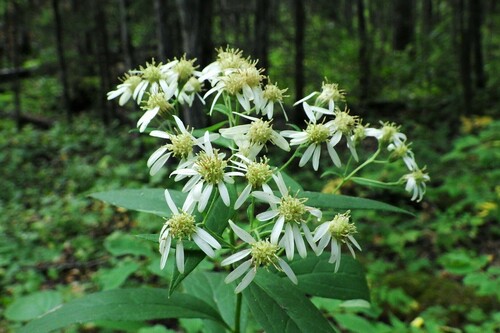
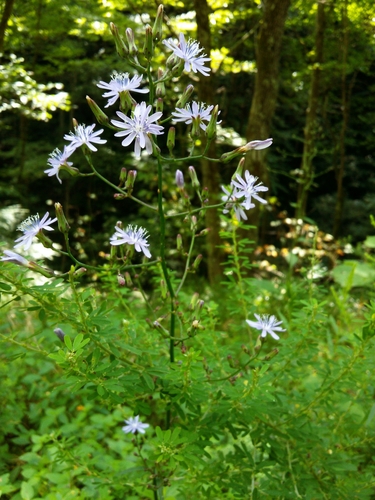
Lactuca floridana (L.) Gaertn. is a tall plant that reaches heights between 0.9 and 2.4 meters (3 to 8 feet). It typically grows unbranched from a central hairless stem that is either light green or reddish green, and produces pure white milky sap. Its leaves are arranged alternately along the stem, shaped lanceolate-oblong, and can grow up to 25 cm (10 inches) long and 8 cm (3 inches) wide. Leaf form is variable: leaves can be either lobed or unlobed, and the largest leaves are often deeply pinnately lobed. The top of the stem holds a multibranched inflorescence that carries many flower heads. Each flower head contains 10 to 20 blue or white ray florets, and has no disc florets. The fruit it produces is a brown achene. This species is native to North America. In the United States, its native range extends from Texas in the west, north to the Canadian border, east to Massachusetts, and south to Florida. In Canada, it is native to Manitoba and Ontario; it is possibly extirpated in Manitoba, and classified as critically imperiled in Ontario. It grows in a variety of habitats including disturbed areas, prairies, roadsides, pastures, and miscellaneous waste areas. Lactuca floridana blooms from July through October. The nectar and pollen of its flowers attract bees. The plant is edible, and can be cooked and eaten as leafy greens.