About Lactifluus volemus (Fr.) Kuntze
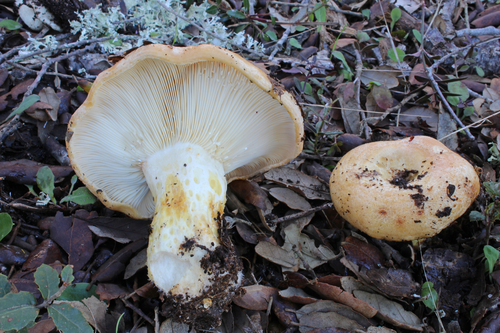
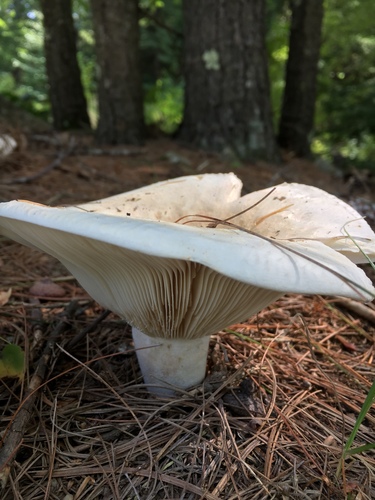
The fruit body of Lactifluus volemus has a fleshy, firm cap with a velvety or smooth surface. The cap's shape changes as it matures: it starts convex with inward-curved edges, then becomes flat with a central depression. The cap typically measures 5 to 11 cm (2–4+1⁄2 in) in diameter, and its color ranges from apricot to tawny. Cap coloration has been noted to be somewhat variable across specimens from Asia, Europe, and North America.
The stem is 4 to 12 cm (1+1⁄2 to 5 in) tall, and 1 to 1.5 cm (3⁄8 to 5⁄8 in) thick. It is slightly lighter in color than the cap, firm, and has a velvety or smooth surface that sometimes has longitudinal depressions running along its length. The gills are adnate to slightly decurrent, brittle, narrow, closely spaced, and sometimes forked. They are normally pale golden yellow, and turn brown when bruised. Short gills that do not reach the stem, called lamellulae, are interspersed between the full-length gills. The flesh is whitish and firm.
The mushroom has a somewhat fishy odor; one source describes the odor as "like a dead shad, which anglers will tell you is probably the most malodorous freshwater fish". The odor becomes more concentrated when fruit bodies are dried. One of the species' most distinctive features is its abundant latex: even a small nick to the gills will cause the milky substance to "weep" out. The latex typically leaves brown stains on any surface it contacts.
Like all milk caps, L. volemus forms ectomycorrhizae, mutually beneficial symbiotic associations with various tree species. In this relationship, the fungal hyphae grow around and between the cortical cells of the plant's roots, but do not penetrate the cells. The hyphae extend out into the surrounding soil, increasing surface area for absorption to help the plant take up nutrients from the soil. It grows at the base of both coniferous and broad-leaved trees, though it is more common in deciduous woods, and may sometimes be found growing in peat moss beds. Fruit bodies appear between summer and autumn, and are common. They grow either solitarily or in groups, and are more abundant in warm, humid weather.
Lactifluus volemus occurs in warm temperate regions, as well as some subtropical and tropical regions of the Northern Hemisphere. It is widely distributed across Europe, though it is declining in some countries, and is considered locally extinct in the Netherlands and Flanders due to its rarity there. It is also known from across Asia, including China's Qinling Mountains, Guizhou Province, and Yunnan Province, plus Japan, India, Korea, Nepal, and Vietnam. Collections have also been made in the Middle East, including Iran and Turkey. In North America, it can be found in southeast Canada, the East Coast of the United States, Mexico, and Central America's Guatemala.
Fruit bodies of L. volemus can be inhabited by limoniid fly species such as Discobola marginata or Limonia yakushimensis, as well as several species of fungi-dwelling mites. The flies act as hosts for the mites in a symbiotic association called phoresis, where the mites are mechanically carried by the fly host. Mites are too small to travel the relatively long distances between mushrooms on their own, while larger insect hosts can transfer mites between their preferred feeding habitats.
Despite the unappealing fishy scent that develops after the mushroom is picked, Lactifluus volemus is edible and recommended for culinary use. Like most milk caps, it has a slightly granular texture that some people find unappetizing, and the fishy odor disappears during cooking. The latex only has a mild taste. The species is considered a good choice for novice mushroom foragers to eat. It is best prepared with slow cooking to prevent it from becoming too hard; specimens rehydrated after drying require longer cooking to remove the grainy texture. It has been recommended for use in casseroles and thick sauces, while pan frying is not recommended due to the large amount of latex it exudes. The species is a good source of protein and carbohydrates. L. volemus is one of several milk cap species sold in rural markets of China's Yunnan Province, and is among the most popular wild edible mushrooms collected for consumption and sale in Nepal. In their 2009 book on North American milk caps, Bessette and colleagues call L. volemus "the best-known and most popular edible milk mushroom" in the eastern United States. One recorded case notes two elderly people developed transient pancreatitis after eating L. volemus in central Anatolia, Turkey. Both had eaten the mushroom, known locally as Tirmit, many times before, and their condition resolved on its own.