About Lactifluus piperatus (L.) Roussel
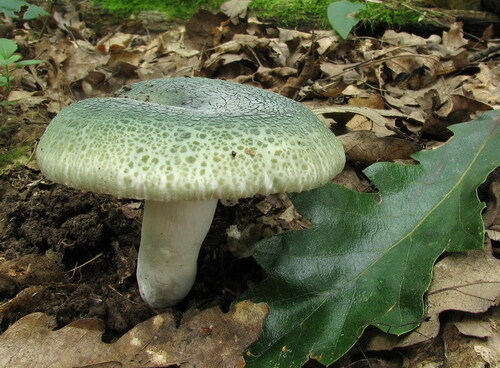
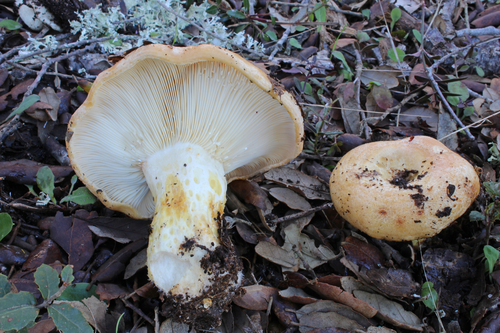
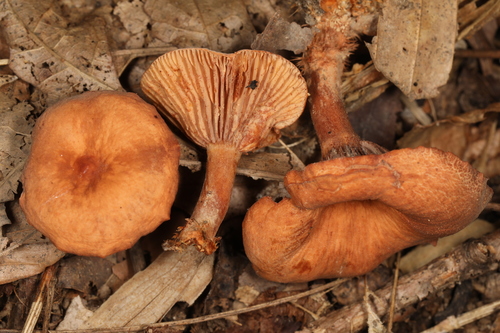
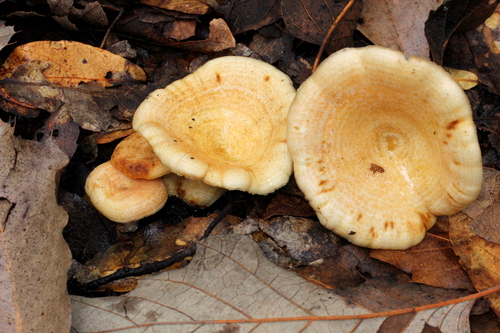
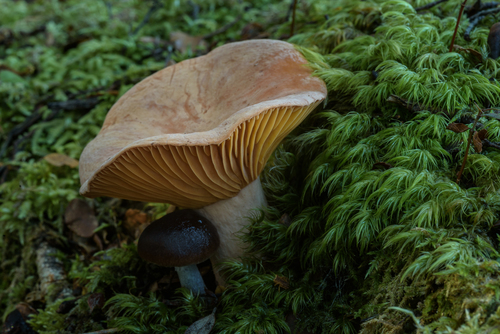
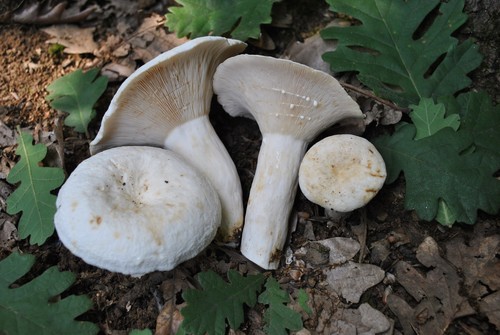
The cap of Lactifluus piperatus measures 6–16 centimetres (2+1⁄4–6+1⁄4 in) across, is convex in shape, and depressed at the center. It is creamy-white, staining tannish as it ages, and is glabrous (hairless) but not glossy; it may crack when growing in dry areas. The stipe (stem) is white, smooth, cylindrical, 2–8 cm (1–3 in) long and 1–3 cm (1⁄2–1+1⁄4 in) thick, and sometimes tapers toward the base. The mushroom has a thick layer of firm white flesh. Its decurrent gills are especially crowded and narrow, matching the stem's white color and turning creamy as the mushroom ages. Like other species related to Lactarius, Lactifluus piperatus produces abundant white milk (latex), which dries to an olive-green color. It leaves a white spore print. Its spores are elongate, elliptic or amyloid, ornamented (a trait it shares with L. vellereus), measure 4.5–9.5 by 5–8 μm, range from roundish to elliptical, and have tiny warts. In a broad sense that likely includes several separate species, Lactifluus piperatus is native to Europe, the Black Sea region of northeastern Turkey, and eastern and central North America east of Minnesota. It has been accidentally introduced to Australasia, where it grows under both introduced and native trees. It grows on the ground in deciduous woodland, most often under beech (Fagus), and can be found from summer through autumn and into early winter. It is relatively common, but less common than the similar species L. vellereus. It grows either alone or in scattered groups, and is sometimes found growing alongside Russula cyanoxantha. Red squirrels commonly use Lactifluus piperatus as a food source. It is one of several species that is parasitized by Hypomyces lactifluorum, commonly known as the lobster mushroom. Because Lactifluus piperatus contains auxins in its metabolites, it can be used as a rooting hormone to support seedling growth for multiple plant species, including hazel, beech, and oak. In the 19th century, it was used as a folk remedy for tuberculosis, though it had no effect on the disease. In modern times, Lactifluus piperatus has been found to work as an antiviral agent, and its latex has been used to treat viral warts.