About Lactarius vietus (Fr.) Fr.
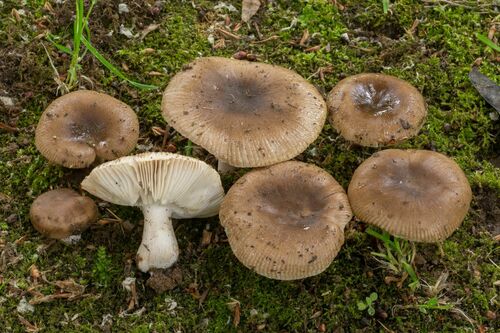
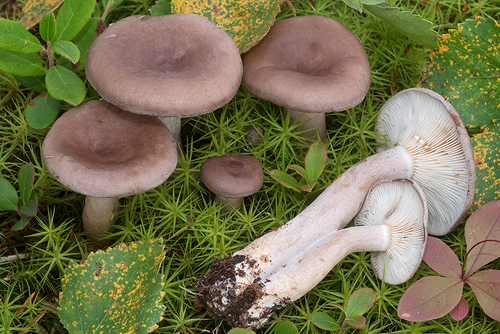
Lactarius vietus (Fr.) Fr. typically has a cap that measures 2.5 to 7.5 centimetres (1 to 3 inches) across, with a flattened-convex shape. In some cases, the cap becomes widely funnel-shaped, and sometimes has a broad or pointed umbo, though the centre of the cap is typically depressed. The cap is grey, and may have violet, flesh-coloured, pale yellowish-brown or red tints; it is paler near the cap margin in young mushrooms. Very pale, non-albino specimens of this species have been recorded in the United States. The cap margin curves inwards in young mushrooms, and has an irregular wavy outline. The cap surface is smooth, and becomes slimy or sticky when wet. The stem measures 2.5 to 8 centimetres (1 to 3 inches) in length and 2 to 7 centimetres (0.8 to 3 inches) in width, and is generally cylindrical. Sometimes the stem narrows towards the base, or takes on a club shape. The stem is whitish or greyish, paler at the top, and is rather weak and breaks easily. The flesh is whitish-buff, and is often absent in the stem, leaving the stem hollow. The crowded gills are either decurrent (running down the stem) or adnate (connecting to the stem along their entire depth), and range in colour from whitish to a dirty buff. They are thin and flaccid, and have three to four tiers of lamellulae (short gills that do not extend from the cap margin to the stem). The gills produce white milk, which dries to a brownish or greenish grey after approximately 20 minutes. When a drop of FeSO4 solution is applied to the mushroom's flesh as a chemical colour test, the flesh slowly stains greyish. Lactarius vietus is fairly common, and grows in moist areas under trees in autumn, often among Sphagnum moss. While it strongly prefers growing with birch, it has also been found growing under oak. It forms an ectomycorrhizal relationship with the trees it grows with. It can also grow on rotting wood or other hard surfaces, and specimens have been observed on both conifer and hardwood logs. These rotting-wood specimens are typically smaller, and may represent a dwarf variety. Even though it grows on rotting wood, the species is not saprotrophic; instead, the species' mycelia connect to tree roots growing through or near the wood. This adaptation is particularly useful when the soil is wet or nutrient-poor. Mushrooms of this species sometimes grow in large numbers, but can also grow in tight clumps, or solitarily when growing out of season. This species occurs in Europe, with collections recorded in Scandinavia, the British Isles, Bulgaria, Germany, and northern Turkey. In North America, it is recorded as common in Canada, and in both northern and southern United States. In northern Asia, it has been found in regions near the Oka River and the central Angara River in Siberia; in eastern Asia, it has been collected in China.